
Learn Classification
3 expert-rated courses covering Classification. Compared by rating, price, difficulty, and job relevance so you can pick the right one.
Classification is a core skill for data scientists, machine learning engineers, and business analysts across sectors like finance, healthcare, and e-commerce. Proficiency in classification can increase salaries by 15-25% and hiring is projected to grow 25% annually through 2026 to meet AI adoption.
Catalog analysis updated . Ratings are independent editorial scores. Read the rating methodology.
Key Facts About Classification
- 1Classification models use techniques like logistic regression, decision trees, and support vector machines to categorize new observations.
- 2Popular open-source classification libraries include scikit-learn, TensorFlow, and Pytorch.
- 3Evaluation metrics for classification models include accuracy, precision, recall, and F1-score.
- 4Common classification applications include image recognition, spam detection, and credit risk assessment.
- 5Challenges in classification include handling imbalanced datasets, selecting relevant features, and avoiding overfitting.
Top Classification Courses
Understanding Machine Learning
Learn machine learning fundamentals. Understand supervised, unsupervised, and reinforcement learning concepts with practical examples.
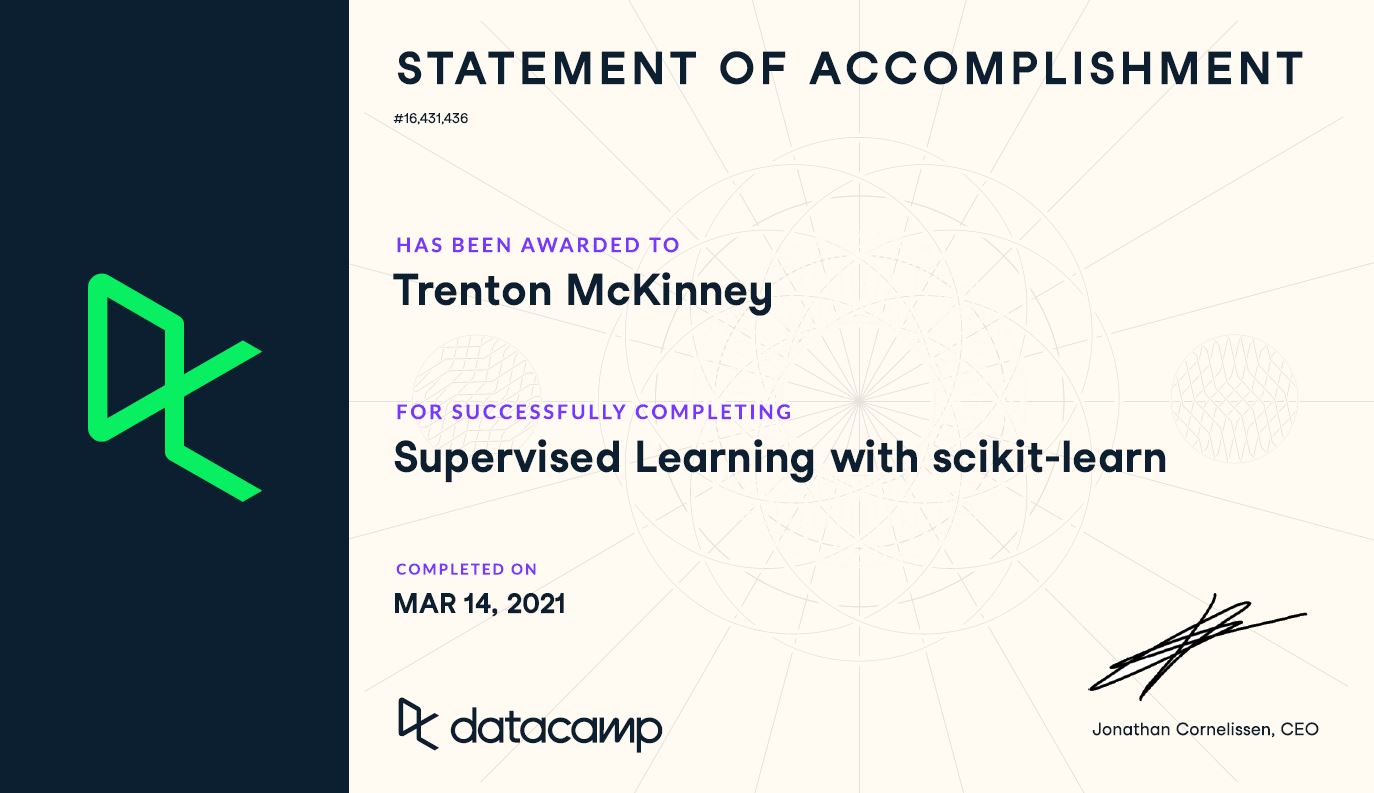
Supervised Learning with scikit-learn
Hands-on supervised learning with scikit-learn. Build classification and regression models, tune hyperparameters, and evaluate performance.
Natural Language Processing Essentials
Master essential NLP skills and techniques for text processing and analysis. Cover sentiment analysis, classification, sequence models, and practical applications. Learn best practices for building robust NLP systems.
Pro Tips for Learning Classification
- #1Start with supervised learning classification algorithms like logistic regression and decision trees before moving to more complex neural networks.
- #2Use cross-validation to properly evaluate your classification model's performance on unseen data.
- #3Spend time on data preparation - clean, preprocess, and engineer features to improve your model's accuracy.
Why Learn Classification?
- Classification skills are in high demand as AI is adopted across industries.
- Understanding classification algorithms and metrics can boost your career as a data scientist or machine learning engineer.
- Mastering classification enables you to build intelligent systems that make accurate predictions and decisions.