
Learn scikit-learn
4 expert-rated courses covering scikit-learn. Compared by rating, price, difficulty, and job relevance so you can pick the right one.
Proficiency in scikit-learn is in high demand across industries like tech, finance, healthcare, and scientific research, where advanced data analysis and predictive modeling are critical. The average salary uplift for scikit-learn skills is 15-25%, and demand is projected to grow 30% annually through 2026 as AI/ML adoption accelerates.
Catalog analysis updated . Ratings are independent editorial scores. Read the rating methodology.
Key Facts About scikit-learn
- 1scikit-learn was first released in 2010 and is now one of the most popular open-source ML libraries, with over 30 million downloads per year.
- 2The library provides over 60 machine learning algorithms, including SVMs, random forests, gradient boosting, k-means, and more.
- 3scikit-learn is built on top of NumPy, SciPy, and Matplotlib, and integrates seamlessly with the Python data science ecosystem.
- 4It is designed to be simple and efficient, with a user-friendly API and clear documentation that makes it accessible for beginners and experts alike.
- 5scikit-learn is actively maintained by a large community of contributors, ensuring frequent updates and the addition of new features.
Top scikit-learn Courses

Machine Learning and AI with Python
Harvard's ML course covering supervised learning, regularization, neural networks, and practical AI implementation with Python and scikit-learn.
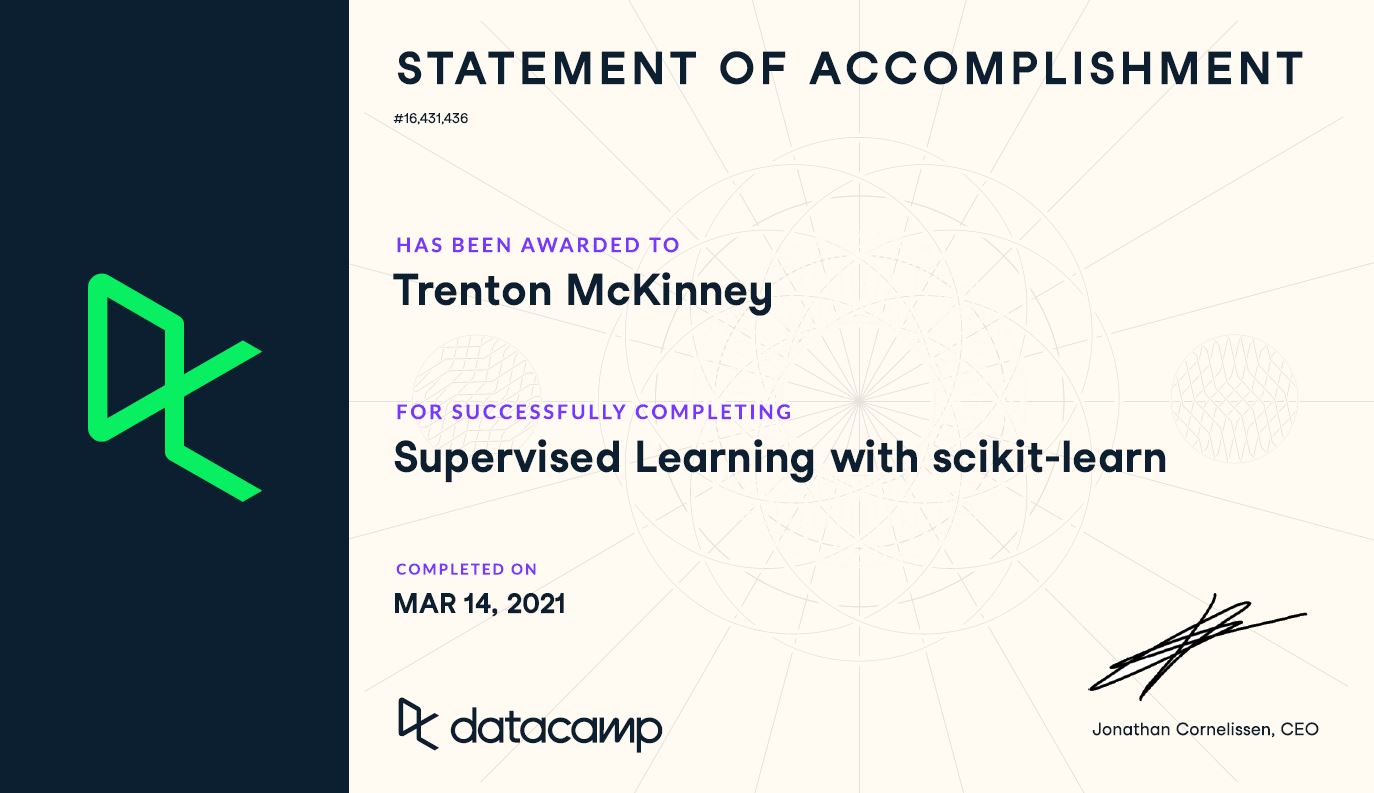
Supervised Learning with scikit-learn
Hands-on supervised learning with scikit-learn. Build classification and regression models, tune hyperparameters, and evaluate performance.
Machine Learning with Python
Learn machine learning using Python, the industry-standard language for data science and AI. Work with popular libraries like scikit-learn, TensorFlow, and pandas to build practical ML models. Ideal for intermediate programmers wanting to enter the machine learning field.
Natural Language Processing in Python
Learn NLP in Python - text preprocessing, machine learning, transformers & LLMs using scikit-learn, spaCy & Hugging Face.
Pro Tips for Learning scikit-learn
- #1Start with the scikit-learn user guide and official tutorials to build a solid foundation in the library's core concepts and APIs.
- #2Practice implementing end-to-end ML pipelines on diverse datasets, experimenting with different algorithms and hyperparameters.
- #3Stay up-to-date with the latest developments in the scikit-learn community by following the project's blog and GitHub repository.
Why Learn scikit-learn?
- Become proficient in the most widely-used open-source machine learning framework, giving you a competitive edge in the job market.
- Develop critical skills in data preprocessing, model selection, hyperparameter tuning, and performance evaluation.
- Apply scikit-learn to solve real-world problems across industries, from predictive analytics to computer vision and natural language processing.