
Machine Learning Specialization
Coursera · Stanford University, DeepLearning.AI · Updated
AI Tutor Rating
8.6/10
Duration
2 months at 10 hours a week
Classes
35
Beginner-friendly three-course program covering supervised and unsupervised learning, neural networks, recommender systems, and best practices.
The Machine Learning Specialization on Coursera is a beginner-friendly three-course program created by Stanford University and DeepLearning.AI. It covers core machine learning concepts including supervised and unsupervised learning, neural networks, recommender systems, and best practices. Designed to be completed in about two months at 10 hours per week, the specialization consists of 35 lectures. It serves learners aiming to build foundational machine learning skills, from building models with NumPy and scikit-learn to training neural networks with TensorFlow.
What you'll learn in Machine Learning Specialization
Our Review of Machine Learning Specialization
The Machine Learning Specialization offers a structured, three-course progression that effectively demystifies machine learning for beginners. The curriculum moves logically from foundational concepts like building ML models with NumPy and scikit-learn, to intermediate topics like training neural networks with TensorFlow, and finally to applied areas like unsupervised learning, clustering, and building recommenders. This scaffolded approach, combined with the stated prerequisite of 'None,' suggests the course is carefully designed to build confidence and practical ability step-by-step.
The teaching format, delivered through Coursera's subscription model, provides flexibility and includes a certificate of completion. The 2-month estimated duration at 10 hours per week indicates a substantial but manageable commitment for a serious beginner. The learning outcomes are action-oriented, promising that a learner will be able to apply specific techniques like clustering, anomaly detection, and reinforcement learning, which points to a hands-on, project-based component within the courses. The value is tied directly to the learner's pace; a focused student can complete the specialization for one or two months of subscription fees, making it cost-effective compared to traditional education.
However, the breadth of topics—from fundamentals to neural networks and reinforcement learning—packed into a beginner course suggests the coverage of each area may be introductory rather than deep. A learner will gain a strong conceptual map and initial practical skills, but mastering TensorFlow or complex recommender systems will require further, more specialized study. The specialization's greatest strength is its role as a comprehensive and credible on-ramp, created by authoritative institutions, that equips learners with the foundational knowledge to then pursue more advanced or niche topics in machine learning.
Pros and cons of Machine Learning Specialization
Pros
- Beginner-friendly with no prerequisites, making advanced topics accessible
- Structured, three-course progression from fundamentals to applied techniques
- Taught by highly credible institutions, Stanford University and DeepLearning.AI
- Hands-on, practical outcomes including building models with NumPy, scikit-learn, and TensorFlow
- Flexible subscription pricing on Coursera allows learners to control cost based on their pace
Things to consider
- The broad scope may mean individual topics receive introductory rather than in-depth coverage
- Subscription model requires ongoing payment until completion, which could increase cost for slower learners
- Lacks advanced prerequisites, so experienced programmers might find early sections too basic
Who should take Machine Learning Specialization?
The Machine Learning Specialization is best for career-changers, students, or professionals from non-technical fields who need a structured, credible, and complete introduction to machine learning. It fits learners who want to go from zero knowledge to building and training basic models within a few months, and who value the flexibility of a subscription-based online platform with a certificate from top institutions.
Course curriculum for Machine Learning Specialization
Machine Learning Specialization at a glance
| Provider | Coursera |
|---|---|
| Instructor | Stanford University, DeepLearning.AI |
| Level | Beginner |
| Time to complete | 2 months at 10 hours a week |
| Pricing | Subscription (Coursera) |
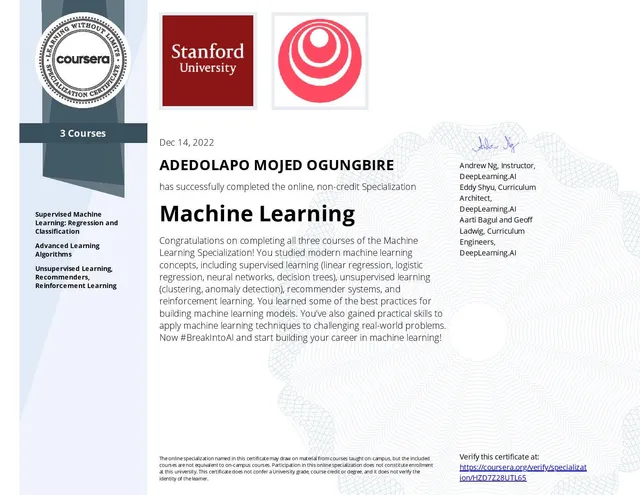
| Certificate | Certificate |
| Prerequisites | None (beginner-friendly) |
Fit
Best for
Not ideal for
The bottom line on Machine Learning Specialization
The Machine Learning Specialization is a well-structured and authoritative entry point into the field, successfully balancing breadth and beginner accessibility. While experienced developers may seek deeper dives, it delivers on its promise to provide a solid foundation in both classical and modern ML techniques, making it a strong value for its target audience of newcomers seeking a comprehensive start.
Machine Learning Specialization: frequently asked questions
What exactly is covered in the Machine Learning Specialization on Coursera?
The Machine Learning Specialization is a three-course program covering supervised and unsupervised learning, neural networks, recommender systems, and ML best practices. The curriculum includes building models with NumPy and scikit-learn, training neural networks with TensorFlow, and applying clustering, anomaly detection, and reinforcement learning.
Is the Machine Learning Specialization suitable for someone with no coding or math background?
Yes, the Machine Learning Specialization is listed as having no prerequisites and is described as beginner-friendly. The course is designed to start from foundational concepts, making it accessible to learners new to the field.
How much does the Machine Learning Specialization cost and is the certificate worth it?
The Machine Learning Specialization uses Coursera's subscription pricing. You pay a monthly fee until you complete the estimated 2-month program. The included certificate from Stanford and DeepLearning.AI adds credibility for resumes and professional profiles.
How does this Machine Learning Specialization compare to a single introductory course?
Unlike a single course, this Machine Learning Specialization is a comprehensive, multi-course program. It provides a broader progression from fundamentals to applied techniques like neural networks and recommenders, offering a more complete foundational education for beginners.
What is the best way to succeed in the Machine Learning Specialization?
To get the most from the Machine Learning Specialization, commit to the suggested 10 hours per week pace to finish in 2 months, minimizing subscription costs. Actively practice the hands-on outcomes, like building models with the listed tools, to solidify the introductory concepts covered.