
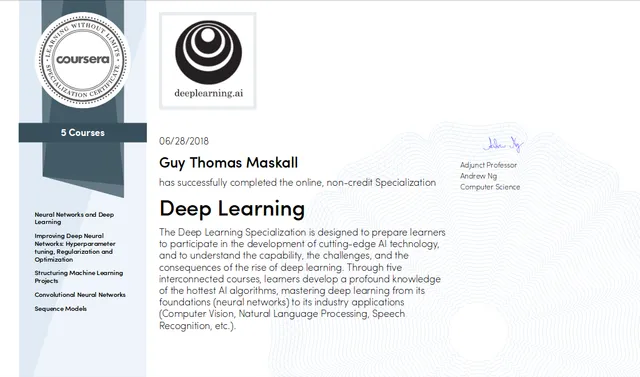
Deep Learning Specialization
Coursera · DeepLearning.AI · Updated
AI Tutor Rating
8.6/10
Duration
3 months at 10 hours a week
Classes
35
Five-course specialization on deep learning architectures including CNNs, RNNs, and transformers, with practical projects in TensorFlow.
Deep Learning Specialization on Coursera, produced by DeepLearning.AI under Andrew Ng, is a comprehensive 3-to-6-month program spanning roughly 150 lectures across neural networks, CNNs, RNNs, transformers, and generative models. Designed for practitioners who already have Python and basic machine learning knowledge, it targets engineers and researchers who want to move from ML fundamentals into production-ready deep learning. The curriculum culminates in advanced topics including diffusion models, multimodal AI systems combining text, vision, and audio, and transformer architectures studied in depth.
What you'll learn in Deep Learning Specialization
Our Review of Deep Learning Specialization
The Deep Learning Specialization is structured as a deliberate progression rather than a collection of loosely related modules. Early chapters establish neural network fundamentals before advancing through CNNs, RNNs, and transformer architectures, giving learners a conceptual scaffold that makes later material on generative architectures and diffusion models feel earned rather than dropped in without context. With 12 curriculum chapters and 150 lectures, the course is dense by design, and that density is a feature for anyone serious about the field. Chapters dedicated to troubleshooting and debugging, and to deep learning best practices, signal that DeepLearning.AI is preparing learners for real deployment scenarios, not just academic exercises.
The three stated learning outcomes are notably ambitious. Understanding transformer architectures in depth, building multimodal AI systems that integrate text, vision, and audio, and implementing diffusion models for generation tasks represent skills that sit at the frontier of applied AI research in 2025. That ambition is appropriate for the ai-research and generative-research categories this course occupies, but it also means learners who underestimate the prerequisite requirement will struggle. Python fluency and a working grasp of basic ML are not soft suggestions; they are genuine entry conditions for a course that moves quickly through foundational material to reach generative and multimodal content.
On value, the subscription pricing model on Coursera means cost scales with how long a learner takes to complete the specialization. A focused learner finishing in three months pays less than one who stretches to six, which creates a real incentive to engage consistently. The certificate awarded upon completion carries the DeepLearning.AI brand, which has meaningful recognition in hiring pipelines for ML engineering and AI research roles. For practitioners looking to validate transformer and generative-model skills on a resume or LinkedIn profile, that certificate is a tangible asset rather than a participation trophy.
Pros and cons of Deep Learning Specialization
Pros
- Covers the full modern deep learning stack, from neural network basics through diffusion models and multimodal systems, in a single coherent specialization.
- Dedicated chapters on troubleshooting, debugging, and best practices prepare learners for real-world deployment rather than stopping at theoretical understanding.
- The transformer architecture coverage is treated as a deep dive rather than a survey, giving learners the conceptual depth needed for AI research and advanced engineering roles.
- DeepLearning.AI's certificate has strong brand recognition in ML hiring pipelines, adding concrete resume value to the learning investment.
- At 150 lectures across 3-to-6 months, the course provides enough instructional volume to build genuine fluency rather than surface-level familiarity with each topic.
Things to consider
- The prerequisite requirement for Python and basic ML knowledge is a hard barrier; learners without that foundation will find the pace overwhelming before reaching the generative and transformer content.
- Subscription pricing means total cost is variable and can climb significantly for learners who need the full six months, making it less predictable than a one-time purchase course.
- The breadth of the curriculum, while a strength for coverage, means some topics like RNNs or CNNs may receive less individual depth than a single-subject course dedicated to those architectures.
Who should take Deep Learning Specialization?
Deep Learning Specialization is best suited for software engineers and ML practitioners who already write Python comfortably and understand basic machine learning concepts, and who want a structured, certificate-bearing path into transformer architectures, generative models, and multimodal AI. It is particularly well matched to professionals targeting AI research, ML engineering, or applied generative AI roles who need both theoretical grounding and hands-on implementation experience.
Course curriculum for Deep Learning Specialization
Deep Learning Specialization at a glance
| Provider | Coursera |
|---|---|
| Instructor | DeepLearning.AI |
| Level | Intermediate |
| Time to complete | 3 months at 10 hours a week |
| Pricing | Subscription (Coursera) |
| Certificate | Certificate |
| Prerequisites | Intermediate; recommended ML experience |
Fit
Best for
Not ideal for
The bottom line on Deep Learning Specialization
Deep Learning Specialization on Coursera is a rigorous, well-sequenced program that takes qualified learners from neural network fundamentals to diffusion models and multimodal AI in a single curriculum. The prerequisite bar is real and the subscription cost rewards focus, but for practitioners ready to commit, the depth of transformer and generative content combined with a recognized DeepLearning.AI certificate makes this one of the more substantive deep learning investments available on the platform.
Deep Learning Specialization: frequently asked questions
What does the Deep Learning Specialization on Coursera actually cover?
The Deep Learning Specialization covers neural networks, CNNs, RNNs, transformer architectures, generative models, diffusion models, and multimodal AI systems combining text, vision, and audio. It also includes chapters on deep learning best practices and troubleshooting, making it a full-stack program rather than a topic-specific course. The curriculum spans 12 chapters and roughly 150 lectures.
What prerequisites do I need before starting the Deep Learning Specialization?
DeepLearning.AI lists Python and basic ML knowledge as prerequisites for the Deep Learning Specialization. These are genuine entry conditions, not suggestions. Learners without Python fluency or a working understanding of machine learning fundamentals will likely struggle to keep pace before the course reaches its more advanced transformer and generative content.
Is the Deep Learning Specialization certificate worth it for job applications?
The Deep Learning Specialization awards a certificate upon completion that carries the DeepLearning.AI brand, which has meaningful recognition in ML engineering and AI research hiring. For practitioners looking to validate transformer, generative model, or multimodal AI skills on a resume or LinkedIn profile, the certificate provides a concrete credential tied to a well-known curriculum.
How does the Deep Learning Specialization compare to taking individual deep learning courses on the same topics?
Unlike standalone courses focused on a single architecture or technique, the Deep Learning Specialization builds a connected progression from neural network fundamentals through CNNs, RNNs, transformers, and diffusion models. That scaffolded structure helps learners understand how the field evolved and how components relate, which individual topic courses typically do not provide.
How can I get the most out of the Deep Learning Specialization given the subscription pricing?
Because the Deep Learning Specialization uses Coursera's subscription model, total cost scales with completion time. Finishing closer to the three-month end of the three-to-six-month range minimizes cost and maximizes value. Setting a consistent weekly schedule before enrolling, and treating the troubleshooting and best-practices chapters as applied checkpoints rather than optional content, will help maintain momentum.