
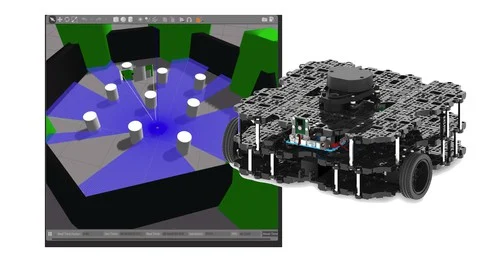
ROS for Beginners: Basics, Motion, and OpenCV
Udemy · Anis Koubaa · Updated
AI Tutor Rating
7.8/10
Duration
14 hours video
Classes
153
Become an expert and learn robotics with Robot Operating System (ROS). Don't be lost in broad docs.
ROS for Beginners: Basics, Motion, and OpenCV is a Udemy course that teaches the Robot Operating System (ROS) from the ground up. It covers core ROS fundamentals, robot motion control, and the integration of OpenCV for computer vision applications. The 14-hour video course, comprising 153 lectures, is designed for learners with basic programming knowledge who want to move from broad documentation to practical, hands-on robotics programming. It culminates in a certificate and a portfolio project, aiming to build skills for autonomous robot programming.
What you'll learn in ROS for Beginners: Basics, Motion, and OpenCV
Our Review of ROS for Beginners: Basics, Motion, and OpenCV
The course structure is comprehensive, moving logically from ROS basics to advanced topics like motion control and OpenCV integration. The curriculum chapters suggest a project-based learning path, starting with 'Getting Started' and progressing through dedicated sections on motion techniques and computer vision architecture before culminating in a 'Portfolio Project & Certification Prep.' This indicates a focus on building tangible, portfolio-ready skills rather than just theoretical knowledge. The 153 lectures within 14 hours of video imply a dense, step-by-step format suitable for beginners who need clear, incremental instruction.
The teaching format is exclusively video-based on Udemy, which offers flexibility for self-paced learning. The outcomes promise mastery of ROS fundamentals with motion control and the ability to program robots for autonomous motion using OpenCV, suggesting the course delivers applied, practical robotics programming skills. The low price point of $12.99 for this volume of content represents significant value, especially with the included certificate, which can provide formal recognition for skill development. However, the prerequisite of basic programming is essential; learners without this will be quickly lost.
The depth appears tailored to bridge the gap between a true novice and a practitioner capable of implementing vision and motion control. The inclusion of 'Testing & Validation' and 'Optimizing ROS' chapters hints at attention to professional practices. The value proposition is strong: for a minimal investment, a motivated learner can gain a structured entry into ROS, bypassing the overwhelming nature of official documentation, and finish with a certifiable project.
Pros and cons of ROS for Beginners: Basics, Motion, and OpenCV
Pros
- Comprehensive curriculum covering ROS fundamentals, motion control, and OpenCV integration in one course.
- Project-oriented structure with a dedicated portfolio project for practical, hands-on learning.
- Excellent value with 14 hours of video content and a certificate at a very accessible price point.
- Clear learning path for beginners, explicitly designed to help learners avoid being lost in broad documentation.
- Focus on applied skills like autonomous motion programming and computer vision architecture.
Things to consider
- Requires a firm grasp of basic programming as a stated prerequisite; not for absolute beginners.
- Solely video-based format may not suit learners who prefer or require supplementary text-based materials.
- The breadth of covering both ROS basics and OpenCV integration in 14 hours may mean some topics are introductory rather than deep-dives.
Who should take ROS for Beginners: Basics, Motion, and OpenCV?
This course is best for programmers or engineering students with basic coding skills who want a structured, practical introduction to ROS. It fits learners aiming to quickly build robotics applications involving motion and computer vision, and who value a project-based approach over theoretical deep-dives. The format suits self-starters who learn well from video tutorials and want a certificate to validate their foundational ROS skills.
Course curriculum for ROS for Beginners: Basics, Motion, and OpenCV
ROS for Beginners: Basics, Motion, and OpenCV at a glance
| Provider | Udemy |
|---|---|
| Instructor | Anis Koubaa |
| Level | Beginner |
| Time to complete | 14 hours video |
| Pricing | $12.99 |
| Certificate | Certificate |
| Prerequisites | Basic programming |
Fit
Best for
Not ideal for
The bottom line on ROS for Beginners: Basics, Motion, and OpenCV
ROS for Beginners: Basics, Motion, and OpenCV is a well-structured and high-value entry point into practical robotics programming. It effectively demystifies ROS and OpenCV integration through hands-on projects, making it a strong choice for cost-conscious learners seeking applicable skills and a certificate. Just ensure you meet the basic programming prerequisite before enrolling.
ROS for Beginners: Basics, Motion, and OpenCV: frequently asked questions
What exactly does the ROS for Beginners course teach you?
The ROS for Beginners course teaches the Robot Operating System (ROS) fundamentals, robot motion control techniques, and how to integrate OpenCV for robot vision. The learning outcomes are to master ROS with motion control, integrate OpenCV, and program robots for autonomous motion.
What programming experience do I need before taking this ROS and OpenCV course?
You need basic programming knowledge as a prerequisite for this course. The curriculum includes hands-on Python work, so familiarity with programming concepts is essential to follow the material on ROS, motion control, and OpenCV integration.
Does the Udemy ROS course provide a certificate and is the cost worth it?
Yes, the course provides a certificate. At the promotional price of $12.99 for 14 hours of video content and 153 lectures covering ROS, motion, and OpenCV, it represents substantial value for learners seeking affordable, structured robotics training.
How does this structured ROS course compare to learning from free online documentation?
This course is explicitly designed so you 'don't be lost in broad docs.' It provides a curated, hands-on path through ROS fundamentals, motion, and OpenCV, which is a structured alternative to navigating and synthesizing disparate, often complex, official documentation independently.
How can I get the most out of the ROS for Beginners course on Udemy?
To get the most from this course, ensure you have the basic programming prerequisite, follow the hands-on Python exercises closely, and complete the portfolio project. Engaging fully with the motion control and OpenCV integration sections is key to achieving the autonomous programming outcomes.