
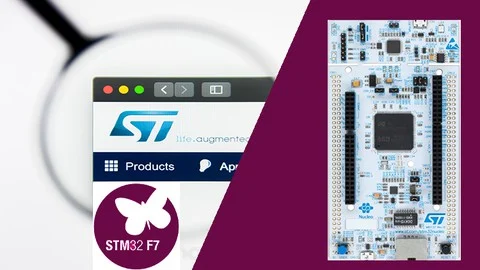
Embedded Systems Bare-Metal Programming Ground Up (STM32)
Udemy · Israel Gbati · Updated
AI Tutor Rating
7.8/10
Duration
16 hours video
Classes
120
Master embedded systems programming from scratch using STM32 microcontrollers covering GPIO, timers, UART, SPI, I2C, and DMA.
Embedded Systems Bare-Metal Programming Ground Up (STM32) is a 16-hour, 120-lecture Udemy course taught by Israel Gbati. It provides foundational and advanced training in programming STM32 microcontrollers without relying on high-level libraries or frameworks. The course systematically covers core embedded concepts including GPIO, timers, and communication protocols like UART, SPI, and I2C, culminating in a capstone project. It is designed for learners with basic C programming skills who want to gain practical, low-level control over hardware for applications in robotics and embedded systems development.
What you'll learn in Embedded Systems Bare-Metal Programming Ground Up (STM32)
Our Review of Embedded Systems Bare-Metal Programming Ground Up (STM32)
The course structure is comprehensive and logically sequenced, moving from an overview of bare-metal programming through specific protocols and advanced concepts before integrating knowledge into a final project. This progression from fundamentals to application is a clear strength. The teaching format relies entirely on video lectures, which provides visual demonstration of coding and hardware interaction but lacks interactive exercises or code-along segments that some learners might prefer for such a hands-on topic.
The curriculum and stated outcomes suggest a learner who completes this course will be capable of programming Arduino and other embedded boards from the ground up, implementing core communication protocols, and interfacing with sensors and actuators. This is a practitioner-level skill set focused on direct hardware control. The pricing at $14.99 represents significant value for 16 hours of specialized content, and the included certificate offers formal recognition of completion, which can be useful for professional development portfolios.
Pros and cons of Embedded Systems Bare-Metal Programming Ground Up (STM32)
Pros
- Comprehensive coverage of essential bare-metal topics including GPIO, UART, SPI, and I2C
- Structured curriculum that builds from overview to advanced concepts and a capstone project
- Clear focus on practical, low-level programming skills for STM32 microcontrollers
- Significant depth for its price point, offering 16 hours of video content across 120 lectures
Things to consider
- Requires a firm grasp of basic C programming as a prerequisite
- Learning format is limited to video lectures without supplementary interactive elements
- Course is specifically tailored to STM32 hardware, limiting direct application to other microcontroller families without adaptation
Who should take Embedded Systems Bare-Metal Programming Ground Up (STM32)?
This course is best for hardware enthusiasts, robotics hobbyists, or early-career embedded systems engineers who already know basic C and want to move beyond Arduino-style abstractions. It fits learners seeking to understand and control STM32 microcontrollers at the register level to build custom robotics projects or deepen their foundational hardware programming skills.
Course curriculum for Embedded Systems Bare-Metal Programming Ground Up (STM32)
Embedded Systems Bare-Metal Programming Ground Up (STM32) at a glance
| Provider | Udemy |
|---|---|
| Instructor | Israel Gbati |
| Level | Intermediate |
| Time to complete | 16 hours video |
| Pricing | $14.99 |
| Certificate | Certificate |
| Prerequisites | Basic C programming |
Fit
Best for
Not ideal for
The bottom line on Embedded Systems Bare-Metal Programming Ground Up (STM32)
Embedded Systems Bare-Metal Programming Ground Up (STM32) delivers on its promise to teach low-level microcontroller programming from the ground up. It is a focused, value-packed course for those ready to tackle the complexity of bare-metal development, though its effectiveness hinges on the learner's existing C proficiency and comfort with a video-only format.
Embedded Systems Bare-Metal Programming Ground Up (STM32): frequently asked questions
What exactly does the Embedded Systems Bare-Metal Programming Ground Up (STM32) course teach?
This Udemy course teaches you to program STM32 microcontrollers without using high-level libraries, covering GPIO, timers, UART, SPI, I2C, and DMA. You will learn to implement communication protocols and interface sensors and actuators for robotics applications.
What skill level is required before taking this bare-metal embedded systems course?
The only stated prerequisite for Embedded Systems Bare-Metal Programming Ground Up (STM32) is basic C programming knowledge. The course dives directly into low-level hardware concepts, so comfort with C is essential.
Does this Udemy course offer a certificate and is the $14.99 price good value?
Yes, the course provides a certificate of completion. Given the 16 hours of specialized video content focused on a niche skill like STM32 bare-metal programming, the $14.99 price point represents strong value for motivated learners.
How does this bare-metal STM32 course compare to typical Arduino tutorials for robotics?
Unlike most Arduino tutorials that use simplified libraries, Embedded Systems Bare-Metal Programming Ground Up (STM32) teaches direct register manipulation and protocol implementation. This offers deeper hardware control and understanding, but requires more effort than typical Arduino courses.
How can I get the most out of the Embedded Systems Bare-Metal Programming Ground Up course?
To maximize learning, have your STM32 development board ready to follow along with the hands-on C programming and GPIO architecture lessons. Actively code alongside the 120 lectures and apply the UART and SPI best practices to the final capstone project.