
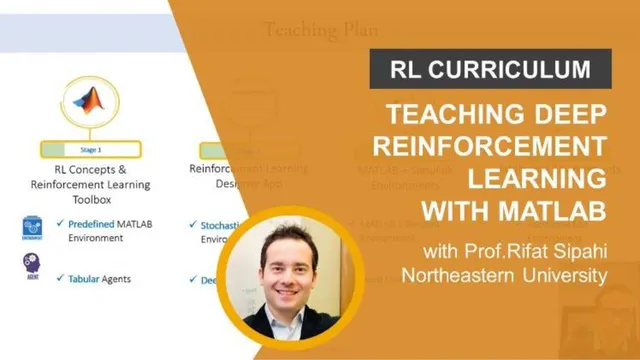
Reinforcement Learning (MathWorks)
Coursera · MathWorks · Updated
AI Tutor Rating
8.3/10
Duration
1-4 weeks
Classes
36
Learn reinforcement learning for engineering applications including control systems, simulation, and deep RL with MATLAB.
The 'Reinforcement Learning (MathWorks)' course on Coursera is a focused, practitioner-level program designed to teach reinforcement learning for engineering applications. Created by MathWorks, the course uses MATLAB to cover core RL concepts and their application to control systems, simulation environments, and robotics. With 36 lectures spanning 1-4 weeks, it targets engineers, researchers, and students with basic programming skills who want to implement RL solutions in technical domains like control and simulation. The learning outcomes emphasize practical skills, including training agents for simulations and applying RL to robotics and control problems.
What you'll learn in Reinforcement Learning (MathWorks)
Our Review of Reinforcement Learning (MathWorks)
The structure of Reinforcement Learning (MathWorks) is clearly oriented toward applied engineering, as evidenced by its curriculum chapters like 'RL for engineering applications' and 'Applied Control Systems.' The teaching format, delivered through 36 lectures, suggests a dense, focused approach that moves from core concepts to practical implementation, culminating in a 'Putting It All Together' module. This progression indicates a hands-on learning path where theoretical knowledge is directly tested in simulation environments using MATLAB.
The course's depth versus difficulty is calibrated for learners who are comfortable with basic programming and are seeking to bridge the gap between general RL theory and domain-specific engineering tasks. The listed outcomes and curriculum suggest a learner will finish with the concrete ability to train RL agents within MATLAB simulations and apply these techniques to classic engineering problems in robotics and control. This is not a superficial overview; it's a toolkit for implementation.
The subscription pricing on Coursera and the availability of a certificate affect the value proposition by offering flexibility and formal recognition. For professionals needing a verifiable credential or those who prefer to learn at an accelerated pace within a month, this model is efficient. However, the value is intrinsically tied to one's need to work within the MATLAB ecosystem, which is a strength for some but a potential limitation for those in open-source-focused environments.
Pros and cons of Reinforcement Learning (MathWorks)
Pros
- Focuses on practical engineering applications like control systems and robotics, moving beyond generic theory.
- Leverages the MATLAB environment, which is a standard in many engineering industries and academic settings.
- Structured, outcome-driven curriculum with 36 lectures designed to build from concepts to implementation.
- Offers a shareable certificate upon completion, adding professional value.
- Efficient duration of 1-4 weeks allows for focused, intensive skill acquisition.
Things to consider
- Requires comfort with MATLAB, creating a barrier for those exclusively familiar with Python or other open-source tools.
- Assumes basic programming knowledge, which may be too vague for absolute beginners needing more guidance.
- The subscription model, while flexible, could become costly if the course takes longer than anticipated to complete.
Who should take Reinforcement Learning (MathWorks)?
This course is an excellent fit for engineers, applied scientists, or graduate students who already use MATLAB in their work or studies and want to add reinforcement learning to their toolkit for solving control, robotics, and simulation problems. It suits learners who prefer a structured, application-focused route over a broad theoretical exploration.
Course curriculum for Reinforcement Learning (MathWorks)
Reinforcement Learning (MathWorks) at a glance
| Provider | Coursera |
|---|---|
| Instructor | MathWorks |
| Level | Intermediate |
| Time to complete | 1-4 weeks |
| Pricing | Subscription |
| Certificate | Certificate |
| Prerequisites | Basic programming |
Fit
Best for
Not ideal for
The bottom line on Reinforcement Learning (MathWorks)
Reinforcement Learning (MathWorks) delivers a potent, industry-relevant curriculum for implementing RL in engineering contexts, provided you are willing to work within the MATLAB framework. It's a strong, practical choice for those whose goals align precisely with its applied focus on control and simulation.
Reinforcement Learning (MathWorks): frequently asked questions
What is the Reinforcement Learning (MathWorks) course on Coursera primarily about?
The Reinforcement Learning (MathWorks) course teaches how to apply reinforcement learning techniques to engineering applications, specifically using MATLAB for control systems, simulation, and robotics problems.
What background do I need before taking this reinforcement learning course?
The course lists only basic programming as a prerequisite, indicating it is accessible but expects learners to be comfortable with coding fundamentals, likely within or adaptable to the MATLAB environment.
Is the certificate for the MathWorks RL course worth it, and how does the pricing work?
The course offers a certificate and uses Coursera's subscription pricing. The certificate adds professional value, and the subscription model is cost-effective if you complete the 1-4 week course promptly.
How does this MathWorks course compare to a general Python-based RL course?
Compared to a general Python RL course, this MathWorks offering is distinguished by its deep integration with MATLAB and its specific focus on engineering applications like control systems and simulation, rather than broader AI topics.
How can I get the most out of the Reinforcement Learning (MathWorks) course?
To get the most from this course, have MATLAB ready for hands-on practice, focus on applying the concepts to your own control or simulation projects, and leverage the structured 'Putting It All Together' final module.