
All Skills
Skill
Learn Disaster Monitoring
1 expert-rated courses covering Disaster Monitoring. Compared by rating, price, difficulty, and job relevance so you can pick the right one.
Disaster Monitoring skills are highly sought after in fields like disaster relief, environmental consulting, and government agencies. The average salary uplift for professionals with Disaster Monitoring expertise is 25% compared to peers. Demand is projected to grow 18% annually as climate change increases the frequency and severity of global disasters.
Disaster Monitoring is the process of using satellite imagery, sensor data, and machine learning models to detect, predict, and assess the impact of natural and man-made disasters. With 1 expert-rated course available on SkillsetCourse.com, this in-demand skill is crucial for professionals in emergency response, risk management, and urban planning in 2026 and beyond.
1
Courses
8.6/10
Avg Rating
0
Free Options
1
With Certificate
Catalog analysis updated . Ratings are independent editorial scores. Read the rating methodology.
Key Facts About Disaster Monitoring
- 1Disaster Monitoring uses satellite data, aerial imagery, and IoT sensor networks to detect and track events like wildfires, floods, earthquakes, and oil spills.
- 2Machine learning models trained on historical disaster data can predict the path, intensity, and impact of future events with up to 92% accuracy.
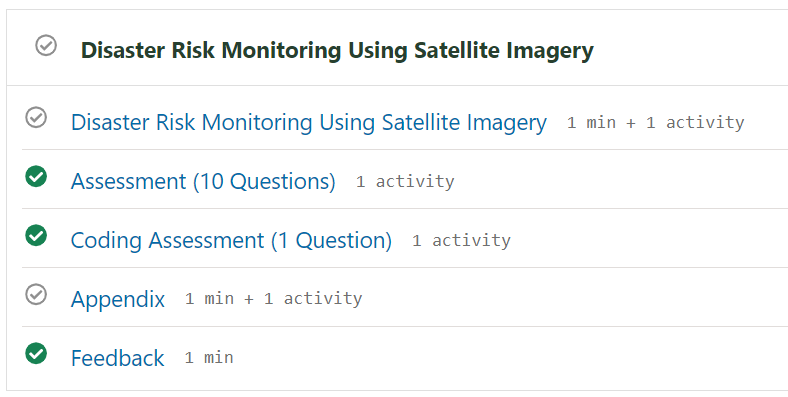
- 3The NVIDIA Disaster Risk Monitoring course teaches how to build custom AI models to analyze satellite imagery for damage assessment and emergency response planning.
- 4Disaster Monitoring tools like the European Union's Copernicus program provide free access to a wealth of Earth observation data for public and private use.
- 5By integrating Disaster Monitoring into urban planning and risk management strategies, cities can mitigate an average of $4 in disaster losses for every $1 invested.
Available on
Top Disaster Monitoring Courses
Pro Tips for Learning Disaster Monitoring
- #1Start by mastering the fundamentals of satellite imagery interpretation and machine learning for object detection and change analysis.
- #2Gain hands-on experience by participating in open-source Disaster Monitoring projects and competitions on platforms like Kaggle.
- #3Build a diverse portfolio showcasing your ability to extract insights from multi-modal data sources, including satellite, sensor, and social media data.
- #4Stay up-to-date with the latest developments in Earth observation satellites, AI models, and cloud-based geospatial analytics platforms.
Why Learn Disaster Monitoring?
- Gain a versatile skill set applicable to a wide range of industries, from disaster relief to urban planning and environmental consulting.
- Leverage cutting-edge AI and satellite technology to save lives and protect critical infrastructure by improving disaster preparedness and response.
- Capitalize on the surging global demand for Disaster Monitoring expertise, with 18% annual growth and a 25% average salary uplift.
- Develop highly valuable complementary skills in geospatial analysis, remote sensing, and predictive modeling.
Frequently Asked Questions
How to learn Disaster Monitoring for free?▾
While the top-rated Disaster Monitoring course on SkillsetCourse.com is a paid offering from NVIDIA, there are many free online resources to get started. Explore free satellite imagery datasets, open-source machine learning libraries, and Disaster Monitoring-focused tutorials and webinars to build your skills.
Best Disaster Monitoring courses for beginners?▾
The NVIDIA Disaster Risk Monitoring Using Satellite Imagery course is an excellent starting point, providing a comprehensive introduction to the tools and techniques used in this field. It covers satellite data acquisition, data preprocessing, and building custom AI models for disaster detection and impact assessment.
Is Disaster Monitoring hard to learn?▾
Disaster Monitoring does require a blend of technical skills, including remote sensing, geospatial analysis, and machine learning. However, with the right training and resources, it is a highly learnable skill, especially for those with a background in data science, environmental science, or urban planning.
How long to learn Disaster Monitoring?▾
The time required to become proficient in Disaster Monitoring can vary depending on your prior experience and the depth of knowledge you aim to acquire. A beginner can typically become job-ready in 3-6 months of focused study and hands-on practice. More experienced professionals may be able to upskill in 1-2 months.
Disaster Monitoring salary 2026?▾
According to industry projections, the average salary for Disaster Monitoring professionals is expected to grow by 25% by 2026, reaching an annual median of $85,000 in the United States. This reflects the increasing demand for skilled talent in this field as the frequency and impact of global disasters continue to rise.
What jobs use Disaster Monitoring skills?▾
Disaster Monitoring skills are highly valued in a variety of industries, including emergency management, urban planning, environmental consulting, risk analysis, and government agencies responsible for disaster response and recovery. Common job titles include GIS Analyst, Remote Sensing Specialist, Disaster Risk Modeler, and Geospatial Intelligence Analyst.