
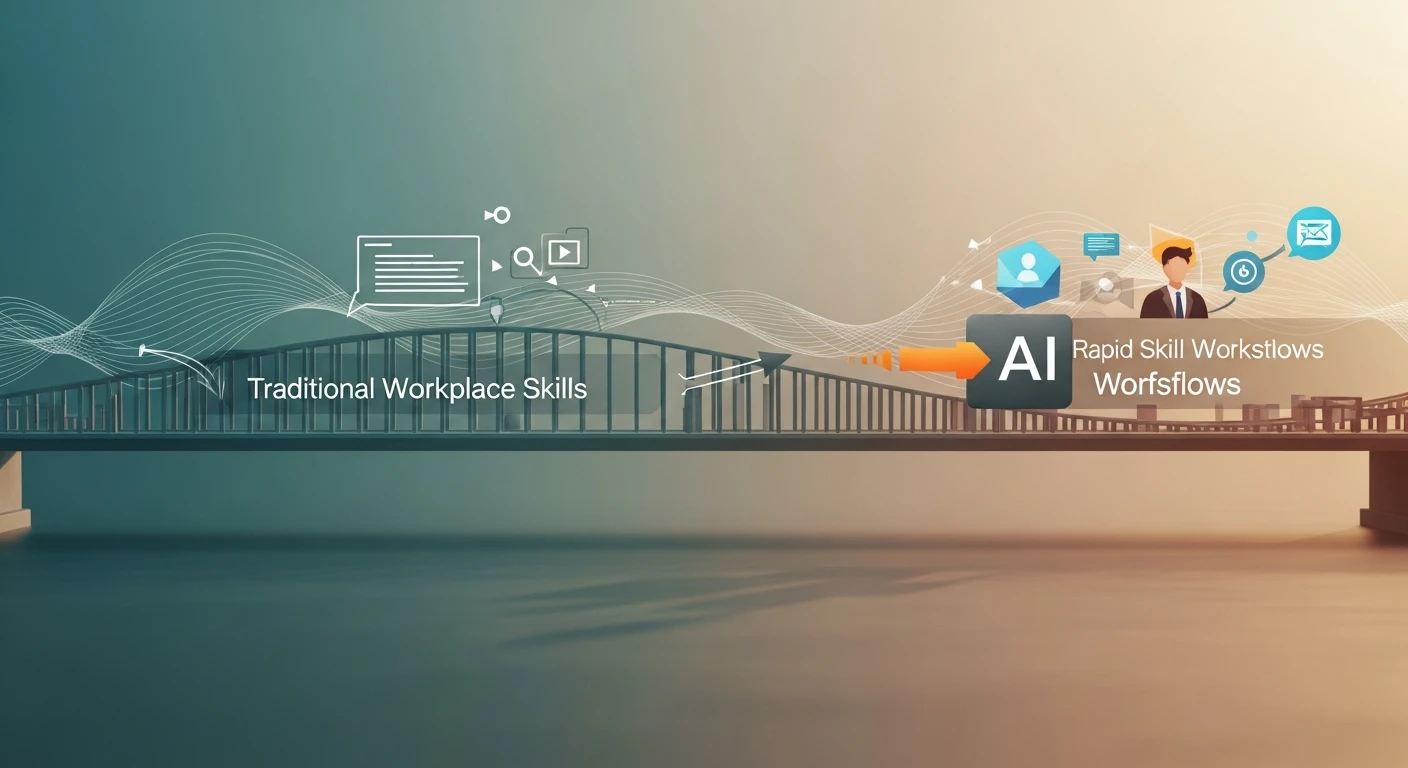
Congress just held a high-level hearing on employer-led AI training, and the message is clearer than ever: companies know exactly what they need, and they're willing to invest in workers who can deliver it. This isn't about mass layoffs or dystopian automation narratives. It's about a fundamental shift in how employers identify, train, and retain talent in an AI-driven economy.
Key Takeaways
- Employers are directly shaping AI training curricula, not waiting for government or educational institutions to catch up
- Congressional hearing signals bipartisan support for industry-led workforce development over top-down mandates
- Worker adaptability and foundational AI literacy now matter more than specialized credentials
- Companies prioritize workers who can integrate AI into existing roles rather than replacing entire job categories
- Upskilling pathways are compressed to months, not years, favoring rapid, employer-driven programs
What Congressional Hearing Reveals About Employer AI Training Priorities
Employers Are Building Their Own Training Pipelines
The congressional testimony made one thing unmistakable: major companies have stopped waiting for traditional education systems. Instead, they're designing their own AI training programs tailored to immediate business needs. Google, Microsoft, Meta, and others aren't just hiring AI specialists-they're training existing employees to work alongside AI tools within weeks or months.
This shift from "hire someone with AI skills" to "train the people we have" represents a seismic change in talent strategy. Rather than the expensive, months-long recruitment cycles of the past, employers are investing in rapid internal reskilling. The hearing confirmed that this approach is far more cost-effective and creates stronger employee retention than constant hiring churn.
Government Support Follows Market Reality, Not the Reverse
Congress heard testimony confirming that government policy is now responding to what employers have already proven works, rather than dictating new rules. This is significant. The bipartisan support documented at the hearing signals that both parties recognize a hard truth: the private sector moves faster than any federal training initiative.
The message from Capitol Hill: support employer-led models, don't regulate them to death. This means funding, tax incentives, and policy frameworks that encourage companies to invest in worker development-but without micromanaging curriculum content.
The Real Skills Employers Want (And It's Not What You Think)
AI Literacy Beats Specialization
Foundational AI literacy-understanding what AI can and cannot do, how to prompt effectively, and when to use specific tools-now ranks above deep technical expertise for most roles. Employers testified that they need workers who can integrate AI into finance, marketing, operations, and customer service, not just data scientists and ML engineers.
This is crucial for your career planning. You don't need a master's degree in machine learning to become valuable to employers. You need to understand how AI tools work in your specific domain and how to amplify your productivity with them. This is exactly what AI & Class courses focus on-practical, role-specific AI integration rather than academic depth.
Adaptability and Problem-Solving Trump Credentials
The congressional hearing underscored that employers now prioritize workers who can learn quickly and solve new problems over those with static certifications. A worker who spent six months learning one AI framework might be obsolete in a year. A worker who understands fundamental AI concepts and can rapidly experiment with new tools remains valuable.
This means your ability to self-teach, ask good questions, and synthesize information matters more than your résumé's pedigree. Companies are actively looking for learners, not just knowers.
Domain Knowledge Becomes the Competitive Advantage
Here's where the hearing's testimony gets interesting: employers are prioritizing workers with deep knowledge of their industry combined with AI fluency. A healthcare worker who understands clinical workflows and can implement AI-assisted documentation is far more valuable than a generic AI specialist. A financial analyst who knows credit risk models and can leverage AI for faster analysis outperforms an AI engineer who doesn't understand finance.
This is why Alternative Trades and Healthcare careers are seeing unexpected resilience. A nurse with AI literacy can drive clinical efficiency. An electrician who understands smart building automation becomes a premium hire. The convergence of domain expertise and AI skills creates genuine scarcity and command higher compensation.
Congressional Hearing Signals: What the Policy Shift Means
Employer Training Programs Get Stronger Policy Support
The hearing confirmed that Congress is moving toward incentivizing and funding employer-led training rather than competing with market forces. This could mean tax credits for companies that invest in worker development, faster visa processes for companies training domestic talent, and partnerships that reduce the regulatory burden on innovative training models.
For workers, this means more training opportunities funded or subsidized by employers themselves. The traditional model-pay for your own MBA or bootcamp-is giving way to employer-sponsored upskilling programs.
Speed Becomes a Policy Priority
Congressional testimony emphasized that compressed training timelines (weeks to months, not years) are more effective than traditional education models for AI skills. This validates the rise of intensive bootcamps, micro-credentials, and employer-led programs over four-year degrees for AI capability.
The practical implication: if you're considering an upskilling investment, prioritize programs that deliver measurable skills in months, not years.
What This Means for Your Career Right Now
Three Actions to Take Before Year-End 2026
Based on what Congress heard from employers:
- Build AI literacy in your current domain. If you work in accounting, learn how AI is reshaping tax preparation and financial planning. If you're in healthcare, understand AI's role in diagnostics and administrative efficiency. The hearing confirmed employers are promoting from within for these roles. Explore domain-specific AI courses that match your industry.
- Develop one specific AI tool fluency. Whether it's prompt engineering with GPT, automation with Claude, or specialized tools in your field, get demonstrable expertise in something employers actually use. The congressional hearing showed companies invest in tools they've already chosen-not generic "AI knowledge."
- Document your learning in a portfolio or case study. Employers hear about credentials; they hire based on demonstrated capability. Show what you've built, optimized, or improved using AI. This is worth 10x more than a certificate.
The Compressed Career Ladder
The congressional hearing reflects a broader reality: the traditional five-to-ten-year climb to senior roles is compressing to 18-24 months for workers who combine domain expertise with AI capability. A junior accountant who learns AI-assisted auditing can reach mid-level roles in two years instead of five. A technician who masters robotics and automation systems becomes a supervisor-track hire immediately.
This favors aggressive, deliberate upskilling. Workers who wait for their company to train them are already behind those who self-directed their learning in the past 12 months.
Employer-Sponsored Programs Are Your Highest-ROI Opportunity
Watch for your company announcing internal AI training initiatives. The congressional hearing confirmed these programs are well-funded, designed for immediate practical impact, and often lead to promotion or role expansion. If your employer offers this, it ranks above external bootcamps in value-it's free, credential-boosting, and directly tied to your advancement path.
Frequently Asked Questions
What skills do employers actually want based on the congressional hearing?
Employers prioritize foundational AI literacy, domain expertise combined with AI fluency, rapid learning ability, and practical tool mastery over deep technical credentials. Specific priorities include prompt engineering, AI-assisted workflow integration, and the ability to evaluate which AI tools solve real business problems.
Will congressional support for employer training replace traditional education?
No, but it will shift the balance. Employer-led programs will dominate for skills like AI implementation, while universities will remain strong for research, theoretical foundations, and credentialing. The real opportunity is combining both-take an employer program for speed, pursue formal credentials for depth if your field requires them.
How long does it actually take to become "AI literate" according to employers?
Based on congressional testimony and employer programs in market, functional AI literacy in your domain takes 4-12 weeks of focused learning. Basic tool competency (one platform or framework) takes 2-6 weeks. Deep expertise in a specialized area takes 3-6 months. Speed depends on your existing domain knowledge and learning intensity.
Should I wait for my employer to offer AI training, or upskill on my own?
Start now, don't wait. If your employer announces a program, great-it supplements what you've already learned and accelerates your progress. Workers who arrive at employer training programs with foundational knowledge advance faster and get selected for premium roles. The congressional hearing confirmed that self-directed learners get first priority in employer development pipelines.
The Bottom Line
Congress just validated what smart workers have known for months: employer-led AI training is the future, and it's already happening. The bipartisan support for industry-driven development means more funding, fewer regulatory barriers, and faster career pathways for workers who are learning to integrate AI into their existing skills.
The congressional hearing wasn't about job losses or robot apocalypses. It was about economic pragmatism: companies need trained workers now, they know exactly what they need, and they're ready to invest. Your job is to make yourself the person they want to invest in.
Start with your domain, pick one AI tool to master, and build a portfolio showing what you've accomplished. That combination-domain expertise plus practical AI capability plus demonstrated results-is exactly what the hearing revealed employers are actively hiring for and promoting from within. The compressed timeline for advancement rewards urgency. Get started this week.