
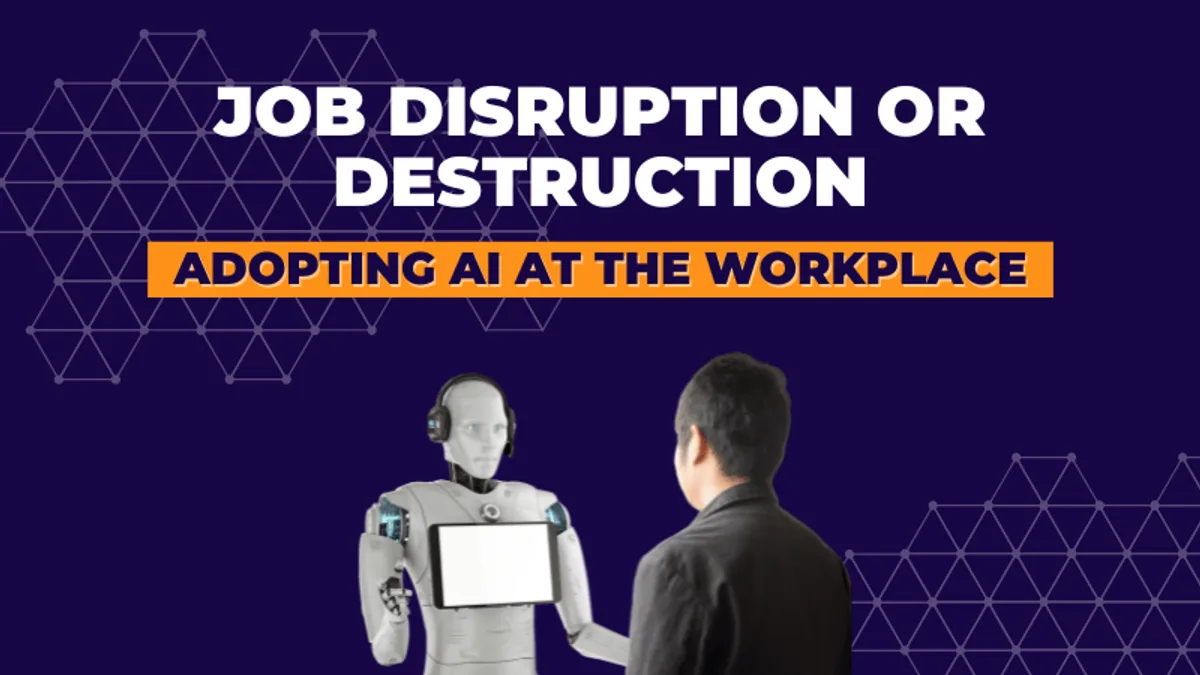
When Facebook co-founder Chris Hughes warns that AI could harm workers even if it doesn't replace them entirely, he's articulating a problem that most career guidance still misses. The narrative has been binary: AI either eliminates jobs or it doesn't. The reality is more dangerous.
Workers face a third outcome: role degradation. Tasks become automated. Compensation stagnates. Autonomy shrinks. Job titles persist while actual work transforms into exception-handling and low-value oversight. This is the disruption nobody talks about-and the one you need to prepare for now.
Key Takeaways
- AI threatens worker quality of life through role degradation, not just job elimination, according to tech leaders and workforce researchers
- Workers in routine cognitive and administrative roles face the highest risk of seeing their jobs hollowed out by automation
- The National Governors Association and U.S. Labor Department are developing AI workforce strategies, signaling federal urgency on reskilling
- Adaptability and cross-functional skills outrank single specializations as the primary defense against disruption
- Career pivots toward AI oversight, data curation, and human-centered roles are opening faster than traditional upskilling can fill them
The Real Threat: AI Degradation vs. AI Replacement
Why Job Elimination Misses the Larger Problem
The public debate focuses on whether AI will eliminate 5% or 50% of jobs by 2030. This framing is incomplete. Role degradation refers to automation of the valuable parts of your job while leaving you with the residual tasks. You keep the title, the paycheck stalls, and the work becomes reactive instead of strategic.
Consider a financial analyst whose job involves 40% data gathering, 40% modeling, and 20% strategic recommendation. AI automates data gathering and modeling. The analyst now spends 80% of their time validating AI outputs and handling exceptions. The role still exists. The career trajectory? Frozen.
Evidence from Corporate AI Adoption
Meta's recent workforce shifts-including selective hiring freezes and reallocation of roles toward AI operations-preview this pattern. Workers aren't being laid off en masse; they're being reassigned to AI management and quality assurance roles that pay less and offer slower advancement.
According to workforce researchers cited in studies covered by the National Governors Association AI and the Future of Work Roundtable, nearly 70% of workers in high-automation-risk roles report reduced autonomy within six months of AI tool integration. Salary growth flattens before positions vanish.
Who's at Risk and Why Government Is Finally Acting
The Occupations Most Vulnerable to Degradation
Roles with high-routine cognitive work are most exposed:
- Financial analysis and accounting - data processing and reconciliation automatable, advisory work increasingly delegated to AI
- Customer service and support - escalation handling remains, but volume and pay-per-interaction decline
- Legal research and compliance - routine discovery and document review moving to AI, specialization requirements rising
- Content creation and copywriting - volume increases, rates per unit decline, editorial oversight burden grows
- Junior software development and QA - code generation reduces junior hiring; remaining roles focus on testing AI-generated code
Federal Workforce Response: The Labor Department's AI Strategy
The U.S. Labor Department's AI workforce strategy discussions at the SCSP summit indicate government recognition of the threat. This isn't hypothetical concern-it's operational planning. Key initiatives include:
- Sector-specific reskilling programs targeting finance, healthcare, and administrative work first
- Wage insurance pilot programs for workers transitioning from automation-exposed roles (more admission of degradation risk than previous administrations)
- Community college partnerships to fast-track training in AI oversight and human-centered roles within 12-18 months
This coordination between governors and federal labor departments reveals something: policymakers expect 2-3 years of significant disruption, not gradual change.
The Skills That Actually Defend Against Degradation
Why Single Specializations Are Now Liability
Traditional career advice says: become really good at one thing. In an AI-driven labor market, this is dangerous. Specialists in narrow, automatable domains (e.g., "SQL query optimization") have zero leverage when AI does it better.
Workers who survived previous automation waves-from manufacturing to data entry-shared a trait: adaptability across related domains. The financial analyst who learns to think like a data engineer. The customer service manager who understands basic prompt engineering. The junior developer who becomes an AI quality auditor.
The Emerging Defensible Skill Set
Across AI Class courses, Robotics programs, and emerging labor market data, five skills consistently protect against degradation:
- AI systems literacy - not prompt engineering, but understanding how your industry's AI tools work, their failure modes, and audit requirements
- Domain expertise + technical translation - ability to bridge non-technical stakeholders and AI systems (e.g., healthcare workers who can specify AI training needs)
- Exception handling and judgment - roles where you catch what automated systems miss. This grows in value as AI handles routine work
- Cross-functional project ownership - manage AI integration projects across departments; demand for these roles is exploding and harder to automate than execution
- Ethical evaluation and risk assessment - as AI becomes embedded, companies need workers who can assess fairness, bias, and regulatory risk. These roles pay 15-30% premiums over pure technical work
Practical Transition Strategy for Vulnerable Roles
If you work in finance, legal, customer service, or junior technical roles:
- Year 1: Observation and upskilling - document exactly which parts of your job are becoming automated. Take 40 hours of AI fundamentals training to understand what's happening in your domain. This isn't optional.
- Year 1-2: Build bridges - volunteer for cross-functional AI projects in your company. Even 2-3 projects provide credibility for internal mobility.
- Year 2+: Lateral move or strategic pivot - either move into AI oversight/operations roles at your company (usually 5-15% pay bump initially, then stronger growth), or transition into adjacent fields with higher AI-resistance (e.g., financial analyst to AI audit specialist, paralegal to legal operations manager).
What This Means for Your Career Right Now
Immediate Action: Assess Your Degradation Risk
Your role is at high degradation risk if all three apply:
- More than 30% of your work involves data processing, research, writing, or analysis that AI tools can now do
- You work in a domain where AI tools already exist (finance, legal, HR, customer service, coding, marketing)
- Your company has already deployed or is piloting AI tools in your function
If this is you, treating this as a career emergency is justified. Not panic-but urgency.
Medium-Term: Build Optionality
The workers who weather labor market transitions aren't the most specialized-they're the most flexible. Start building optionality:
- Get cross-certified in adjacent domains - if you're in accounting, spend 3 months learning audit and risk. If you're in copywriting, learn content operations or product marketing. Cost: $500-2,000 and time.
- Document your exceptions and judgment calls - the places where you caught errors, prevented risk, or made calls that added value. These become your case studies for higher-value roles.
- Network into emerging AI roles at your company - AI operations, prompt engineering oversight, training data curation, model evaluation. These roles pay and these are where the movement is happening right now.
Long-Term: Transition to Roles That Grow With AI
Three categories of work are becoming more valuable as AI advances, not less:
- AI oversight and quality assurance - ensuring AI systems work correctly, catch edge cases, and behave ethically. Demand is growing 40%+ annually.
- Human-centered roles that AI amplifies - therapists, nurses, teachers, senior strategists. AI handles routine parts; humans handle complex judgment and emotional labor.
- Integration and change management - companies need people who understand both the old systems and the new AI workflows. These bridge roles pay 20-40% premiums and exist across every industry.
If you're in an at-risk role, positioning yourself in one of these categories over the next 12-24 months isn't optional-it's a career reset with timeline.
Why Government Action Matters (and Doesn't Matter Enough)
The National Governors Association Is Preparing for Disruption
When state-level executives form an AI and the Future of Work Roundtable, it signals real concern. Governors care about unemployment, tax revenue, and social stability. The existence of this roundtable means workforce disruption isn't theoretical-it's a planning assumption.
What this means for you: Federal reskilling programs are coming, but they will be slow, bureaucratic, and will lag demand by 18-36 months. Public workforce solutions are a backup, not your primary defense.
Why You Can't Rely on Policy to Protect You
Even with government programs, the timing mismatch is brutal. AI tools are disrupting specific roles now. Federal programs train cohorts in 12-18 months. By the time a training program launches and completes, the job market in that role has shifted again.
This means: Your personal upskilling is faster and more reliable than government intervention. Programs matter for safety nets, but primary defense must be self-directed.
Frequently Asked Questions
What jobs are safest from AI degradation in 2026-2027?
Jobs requiring sustained human judgment under uncertainty, emotional labor, or physical interaction in complex environments: senior management and strategy, healthcare (especially nursing and clinical roles), skilled trades (electricians, plumbers, HVAC technicians), education, and complex project management. These roles resist automation longest because AI struggles with exception handling and human relationship context. Within white-collar work, senior advisory roles and compliance/risk management are most protected.
How long does it take to transition into an AI-resistant role from an at-risk position?
Realistically 12-24 months if you're strategic. This includes 3-6 months of targeted upskilling (40-100 hours), 6-12 months of cross-functional project work at your current company to build credibility, and 3-6 months for internal mobility or job search. The key is starting within the next quarter, not waiting for layoff signals.
Are AI certifications worth getting if my role might be degraded?
Specific certifications (AI fundamentals, prompt engineering, data labeling oversight) are worth 2-3 months of effort and $500-1,500, but only if paired with project experience. A certification alone doesn't move you into higher-value roles. The certification + "I led the AI implementation for our department" combo is what opens doors. Prioritize applied experience over badges.
What should I do if my company has already deployed AI in my function?
This is urgency signal #1. Within the next 30 days: (1) Map exactly which tasks are now AI-assisted or fully automated, (2) Identify which remaining tasks require your judgment or domain expertise, (3) Request or volunteer for AI operations/quality work in your department, (4) If your company won't move you, start exploring AI oversight roles at other companies in your industry. You have 6-12 months of advantage before the market saturates with career-changers.
The Bottom Line
Chris Hughes' warning about AI harming workers without replacing them is the real threat vector. Role degradation is harder to see coming than layoffs, but more corrosive to your career trajectory.
The National Governors Association and U.S. Labor Department are signaling that disruption is imminent and structured. This isn't speculation-it's operational planning. That urgency should match your own preparation timeline.
Your defense isn't waiting for better AI policy or government retraining programs. It's building optionality now: learning enough about your industry's AI tools to understand them, volunteering for cross-functional projects that showcase adaptability, and positioning yourself in roles that grow as AI advances rather than shrink.
The window for proactive career moves is closing. Workers who wait for layoff signals will find the best transition roles already occupied by people who moved in 2026. Start your skills assessment this month, not next quarter.