
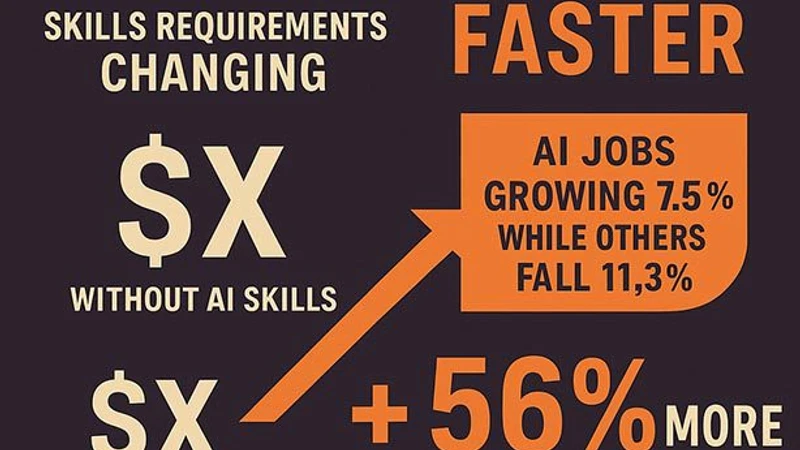
The AI Uncertainty Premium: How Workers Should Prepare When Even Investors Don't Know What's Coming
The AI Uncertainty Premium, coined by billionaire investor Stan Druckenmiller, highlights a need for workers to develop diverse skills due to the unpredictable impacts of AI on employment. To navigate this unknown landscape, workers should focus on optionality, allowing for multiple career paths and transitions in the changing job market.
When a billionaire investor with a 40-year track record says "we don't know how this movie is going to play out," it's worth taking seriously. Stan Druckenmiller's recent candid assessment-that the intersection of AI, jobs, and inflation remains fundamentally unpredictable-cuts through the noise of both utopian and apocalyptic narratives dominating the 2026 labor market conversation.
The uncomfortable truth: nobody has a reliable crystal ball for how artificial intelligence will reshape employment over the next 3-5 years. But that uncertainty itself creates an actionable framework for professional development. If the outcome is unpredictable, the strategy can't be a single bet. It has to be optionality.
The AI Uncertainty Premium: How Workers Should Prepare
The AI Uncertainty Premium describes the precarious nature of job security and career planning in an era where AI is rapidly transforming industries. According to Druckenmiller, this uncertainty prompts workers to adopt a flexible career strategy, creating skill portfolios that allow them to adapt swiftly. By gaining expertise in both core and adjacent skills, professionals can navigate disruptions caused by AI advancements. For instance, pairing domain knowledge with AI operating skills ensures career longevity.
What the Current Evidence Actually Shows
The signals are mixed and contradictory-which is precisely Druckenmiller's point. Simultaneously, we're seeing:
- AI layoffs accelerating: Companies from OpenAI to major tech firms are cutting AI teams, suggesting overexuberant hiring in 2023-2024.
- Deployment acceleration: Companies deploying AI agents into production are scaling headcount in operations, infrastructure, and quality roles-just not in the ways people expected.
- Wage divergence: Salaries for AI-adjacent roles remain elevated, but the jobs themselves are narrowing to specialists and operators, not generalists.
- Geographic concentration: AI work is clustering in three cities (San Francisco, New York, London) and a handful of remote-friendly companies, leaving most workers in traditional markets with limited direct access.
This isn't the "AI will steal all jobs" narrative or the "AI creates more jobs than it destroys" one. It's messier: AI is creating different jobs, destroying some jobs faster than new ones appear in those sectors, and the transition window for displaced workers is compressed and brutal.
The Real Risk: Skill Obsolescence Without a Fallback
Druckenmiller's framing of the problem-inflation, wage pressure, and employment instability as interconnected-points to a deeper issue. If AI accelerates productivity but displaces workers faster than retraining programs can scale, you get stagflation: stagnant wage growth in disrupted sectors, inflation in non-automatable sectors (healthcare, construction, services), and political instability.
For individual workers, this means a single "AI skill" isn't insurance. Learning prompt engineering, no-code AI tools, or even basic Python in 2026 is valuable, but insufficient. The worker who only knows how to use ChatGPT for customer service is three months away from irrelevance if their company deploys an agent.
The worker who understands why AI agents fail, how to audit them, how to manage the human workflows they disrupt, and how to transition teams-that's harder to automate.
The Optionality Strategy for 2026
Given genuine uncertainty, the rational approach isn't to chase the "next big thing." It's to build depth in one domain while systematically adding adjacent capabilities that create multiple paths forward.
Path 1: Become an AI Operator in Your Field
If you're in finance, healthcare, legal, or manufacturing, the immediate opportunity is mastery of domain-specific AI tools and the processes they disrupt. You're not a data scientist; you're someone who understands both the old workflow and how AI changes it. This buys 3-5 years before even this role faces serious automation risk. Use that window to move into Path 2 or Path 3.
Path 2: Build Infrastructure Expertise
Someone has to deploy, monitor, fine-tune, and repair these systems. MLOps, prompt optimization, evaluation frameworks, and synthetic data generation remain harder to commoditize. These roles pay well ($150K-$250K+ at top companies) and the skills transfer across industries. The risk: consolidation to three major cloud providers could compress headcount eventually.
Path 3: Develop AI-Resistant Skills in High-Demand Sectors
Healthcare (nursing, physical therapy, respiratory care), skilled trades (electricians, plumbers, HVAC techs), and emergency services (paramedics, firefighters) have structural labor shortages that AI won't solve in 10 years. Automation can assist but not replace. These careers offer job security, decent pay ($60K-$120K), and geographic independence. They're not glamorous, but they're not at risk from a ChatGPT upgrade.
Path 4: Teach or Govern AI
As more organizations deploy AI systems, demand for ethics review, compliance, internal training, and governance roles is rising. This is a emerging-career path paying $100K-$180K at enterprises and nonprofits. Requires some technical credibility (you can't evaluate ML bias if you don't know what bias is) plus communication and judgment. Less likely to be automated because it involves human accountability.
What You Should Actually Do This Quarter
1. Audit your current role for AI exposure. What tasks would AI tools (agents, LLMs, computer vision) handle first? Those are your 12-36 month risk zone. Plan to expand into the 30% of your job that's hardest to automate.
2. Pick one adjacent skill and commit to depth, not breadth. Not "learn AI"-too vague. Instead: "become expert in evaluating LLM outputs for hallucination in my domain" or "master the operational workflows in my field and learn where AI can integrate." Three months of focused practice beats a year of scattered learning.
3. Build visibility in your industry's AI transition, not just your company's. Join industry forums, attend conferences, read case studies from competitors. You want to know which automation wave is hitting your sector before it hits your desk.
4. Develop an 18-month pivot plan to a less-automatable role. You don't execute it unless needed, but having it sketched out-the certifications, the network, the prerequisite skills-means you can move fast if your current trajectory gets disrupted.
Where Structured Learning Fits
For many professionals, the gap isn't motivation-it's knowing what to learn. Generic "AI courses" are mostly noise in 2026. What actually works:
- Domain-specific AI mastery: Not "intro to machine learning," but "AI for healthcare diagnostics" or "LLMs for legal document review." Combine technical depth with business context. The AI & Mastery program at Skillset Course offers courses in AI at work and automate & operate that anchor this-showing you how AI integrates into real processes, not just the theory.
- Infrastructure-level skills: If you're betting on Path 2, you need rigorous training in MLOps, prompt engineering, and evaluation frameworks. These require hands-on labs and real debugging experience-not video lectures.
- Transition credentials: If you're considering a pivot to healthcare, trades, or emergency services, structured apprenticeship and certification programs cut years off the ramp. Many of these are available through the Alternative Trades & Healthcare program-nursing, electrician, paramedic paths that are systematically structured and employer-recognized.
- Robotics and automation fundamentals: If you work in manufacturing, logistics, or construction, understanding how robots + AI are deployed together-not separately-is increasingly non-negotiable. The Robotics & Automation program covers autonomous systems, industrial automation, and computer vision in practical, job-ready sequences.
But here's the hard part: the course alone doesn't create optionality. You have to intentionally build it into your learning path. Take the AI domain course, then the adjacent operational course, then sketch how you'd pivot to infrastructure or to a trades role. That synthesis is the insurance policy.
The Druckenmiller Principle: Uncertainty Demands Optionality
Investors hedge when they don't know the outcome. Workers should too. You can't predict whether AI will be deflationary (creating abundance) or inflationary (destroying livelihoods faster than new jobs form), or some volatile mix of both. But you can ensure that you're not betting your career on a single outcome.
That means: One core skill you've deepened. One adjacent capability you're building. One fallback plan you could execute in 18 months. And relentless, ongoing exposure to how your industry is actually deploying AI-not the hype, the implementation.
2026 isn't the year to pick a single AI role and bet everything on it. It's the year to build the flexibility to move between roles as the actual disruption becomes clear. And for that, structured learning in multiple domains-applied to your specific situation-isn't optional. It's the floor.
Druckenmiller doesn't know how this plays out. Neither do your competitors. But the ones who move fastest into optionality will have the fewest regrets.
Frequently Asked Questions
- What is the AI Uncertainty Premium?
The AI Uncertainty Premium refers to the unpredictable nature of AI's impact on jobs, urging workers to prepare through skill diversification to mitigate potential career disruptions. - How should workers prepare for AI-related job changes?
Workers should prepare by building optionality into their careers, gaining both domain-specific AI skills and versatile capabilities that allow for job transitions. - Is it better to focus on AI tools or domain expertise?
It's optimal to blend domain expertise with AI tool mastery, enabling workers to remain relevant even as AI tools evolve and disrupt traditional workflows. - What are AI-proof career paths?
AI-proof careers include roles in healthcare, skilled trades, and emergency services, where automation can assist but not fully replace human labor. - How do I start learning AI-resistant skills?
Begin learning AI-resistant skills by enrolling in structured programs that offer domain-specific applications and cross-industry infrastructure expertise like those from Skillset Course.
Recommended courses to act on this
Ready to build these skills? These expert-rated courses on Skillset Course line up directly with what this story covers: