
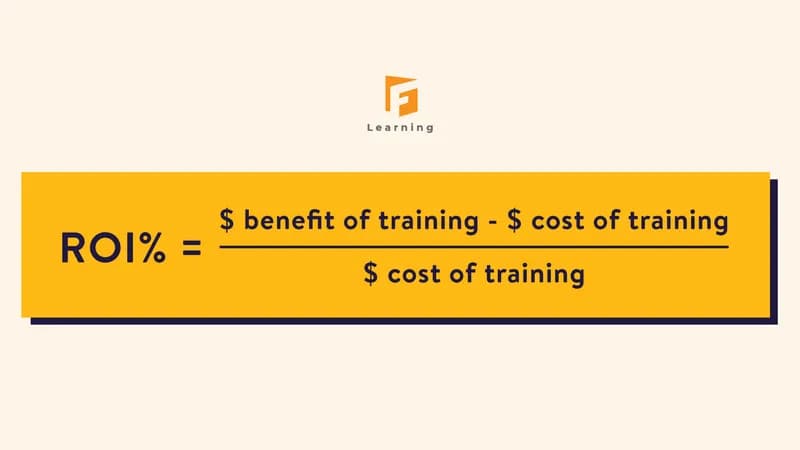
You're about to spend $200 on an AI course. Will it return $2,000 or $0? With over 50,000 AI courses available across platforms, most of your options are a waste of money. But the right course, matched to the right career goal, delivers ROI that makes any other investment look anemic. Here's the framework we use to evaluate training ROI - with detailed examples across AI, trades, and hybrid paths.
The ROI Formula: How We Calculate It
Training ROI isn't as simple as "course cost vs. salary bump." A complete calculation accounts for five factors:
- Salary increase potential (S) - The realistic annual raise or new salary you can expect after completing the training and landing a role
- Job probability (P) - The likelihood you'll actually get hired or promoted based on this training alone (0 to 1 scale)
- Time to outcome (T) - How many months from course completion to the salary increase
- Course cost (C) - Tuition, exam fees, materials, and any subscription costs
- Opportunity cost (O) - Hours spent studying × your current hourly rate (what you could be earning instead)
Training ROI = (S × P) ÷ (C + O)
An ROI above 10x is excellent. Above 50x is exceptional. Below 5x, you should seriously question whether the investment is worth it.
High-ROI Examples (Real Scenarios)
Scenario 1: Career Changer → AI Integration Specialist
- Course: $49 prompt engineering + $149 AI workflow automation course = $198 total
- Time investment: 60 hours over 6 weeks (× $30/hr opportunity cost = $1,800)
- Salary increase potential: $15,000-$25,000/year (moving from admin to AI-augmented role)
- Job probability: 0.7 (high demand, relatively low barrier to entry)
- ROI: ($20,000 × 0.7) ÷ ($198 + $1,800) = 7x in year one, compounding over career
Scenario 2: DevOps Engineer → MLOps Engineer
- Course: $199 MLOps certification prep + $300 Google Cloud ML Engineer exam = $499 total
- Time investment: 120 hours over 3 months (× $55/hr = $6,600)
- Salary increase potential: $25,000-$40,000/year
- Job probability: 0.8 (extremely high demand, transferable skills)
- ROI: ($32,000 × 0.8) ÷ ($499 + $6,600) = 3.6x in year one, but $25K+ annually thereafter
Scenario 3: Career Changer → Welding Certification
- Course: $499 online welding fundamentals + $2,500 hands-on community college program = $2,999
- Time investment: 400 hours over 6 months (× $20/hr = $8,000)
- Salary increase potential: $20,000-$35,000/year (from retail/service to certified welder)
- Job probability: 0.9 (acute shortage, near-guaranteed employment)
- ROI: ($27,000 × 0.9) ÷ ($2,999 + $8,000) = 2.2x in year one, growing with experience
Red Flags: When a Course Will Waste Your Money
- Outdated tech stack - Courses still teaching TensorFlow 1.x, Python 2, or pre-GPT-4 prompt techniques. AI moves fast; content older than 12 months is suspect.
- No portfolio outcomes - If you can't point to a deployed project, GitHub repo, or tangible work product after completion, the course is a lecture series, not training.
- Platform with no employer recognition - A certificate from an unknown platform carries zero signal. Stick to Udemy (for skills), Coursera (for credentials), or vendor certifications (Google, AWS, Microsoft).
- "Comprehensive" courses covering everything shallowly - "Complete AI Masterclass: Beginner to Expert in 40 hours" is a red flag. Real expertise requires focused depth, not surface-level breadth.
- No instructor credentials - Is the instructor a working professional or a content creator who learned last month? Check their LinkedIn, GitHub, and industry experience.
Green Flags: How to Spot High-ROI Training
- Specific, in-demand skill - "RAG Systems with LangChain" beats "Introduction to AI" every time. Targeted skills map to job postings directly.
- Hands-on projects - Courses that produce a deployed model, a working application, or a portfolio piece deliver measurable outcomes.
- Recent content - Updated within the last 6 months, using current frameworks and APIs.
- Instructor with industry experience - Working ML engineers, hiring managers, and practitioners teach what actually matters at work.
- High job relevance score - Directly maps to roles that companies are actively hiring for, not theoretical knowledge.
Use Our Ratings to Maximize Training ROI
Every course in our catalog of 900+ expert-rated courses is scored on exactly the dimensions that predict ROI: AI Tutor Rating (expert quality assessment), Job Relevance (how directly the skills map to hiring demand), Practical Score (hands-on vs. theoretical), and Relevance Badge (whether the content is current). These ratings exist so you can calculate ROI before spending a dollar - not after.