
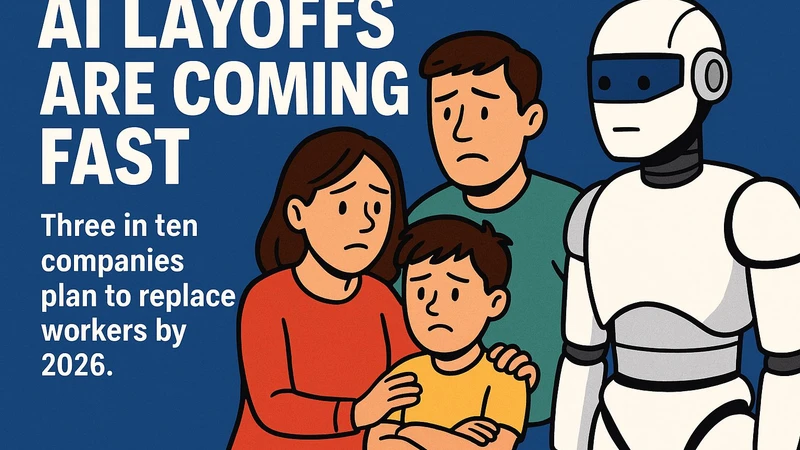
AI Layoffs Are Here: What This Means for Your Career in 2026
The narrative has shifted. For years, the AI industry sold a story of explosive growth and unlimited demand for technical talent. In early 2026, that story is colliding with reality. Major AI companies are cutting staff, venture-backed startups are consolidating, and the job market is showing signs of consolidation rather than expansion.
This isn't a temporary blip. It's a structural realignment that requires immediate action if you're planning an AI career or considering upskilling in 2026.
The Consolidation Is Real, Not Hype
Recent reporting from The New Stack and other industry sources confirms what talent market data has been signaling: AI companies that raised capital at peak valuations are now adjusting headcount to match realistic revenue timelines. This affects not just roles like "prompt engineer" or entry-level AI trainers-it's rippling through mid-level and senior positions.
The contraction is happening across multiple vectors:
- Consolidation of duplicative roles. Companies that hired broad AI teams are now standardizing on specific frameworks and tools, eliminating roles that don't fit the chosen stack.
- Shift from experimentation to production. The "build everything and see what sticks" phase is ending. Teams are getting leaner and more specialized.
- Decline in low-skill AI tasks. Roles that paid $50-80K for prompt engineering or AI content moderation are disappearing as automation and better tooling reduce demand.
- Increased competition for remaining roles. Every laid-off AI engineer is now competing for the same positions, raising the bar for new entrants.
This Isn't Bad News-It's Clarifying News
The layoffs solve a critical information problem: they reveal which AI skills actually create business value and which were inflated by hype and capital abundance.
The roles that are surviving the cuts:
- MLOps and infrastructure engineers who can deploy and maintain AI systems in production
- Domain specialists who understand healthcare, finance, legal, or logistics well enough to implement AI solutions that solve real problems
- Full-stack AI developers who can design systems end-to-end, not just fine-tune a pre-built model
- AI safety and governance professionals as regulatory pressure increases
- Computer vision engineers working on autonomous systems, manufacturing, and robotics applications
The roles being eliminated:
- Junior prompt engineers with no systems design experience
- AI trainers and data labelers competing against cheaper automation
- "AI consultants" who can't code or deploy
- Generalist "AI specialists" in non-technical departments without measurable ROI
The Real Opportunity: Skill Specificity Beats Generalism
The workers who are safest right now are those with deep, defensible expertise in a specific domain. Someone who knows both computer vision algorithms and manufacturing processes is far more valuable than someone who can write a generic prompt.
This is where the labor market is ruthlessly efficient: it pays for leverage. A roboticist who understands ROS, autonomous navigation, and industrial automation can command $150K+ because there are only a few thousand of them globally. A person who took a Coursera AI 101 course competes in a market of millions.
The inflection point in 2026 is that companies are no longer hiring for "AI capability" in the abstract. They're hiring to solve specific problems: build a recommendation engine for e-commerce, deploy computer vision in manufacturing, automate regulatory compliance, reduce inference latency.
What You Should Do Right Now
If you're considering an AI career: Don't chase generalist AI education. Pick a domain-healthcare, manufacturing, finance, logistics-and become genuinely expert in both the domain and the AI tools used there. A healthcare worker who learns to build RAG systems for clinical documentation is more hireable than a generic "AI engineer."
If you're already in AI and employed: Make yourself indispensable by moving toward production systems. The theoretical understanding matters less than the ability to deploy, monitor, and improve systems in live environments. Learn MLOps, understand infrastructure, and become someone who ships.
If you're considering an alternative path: The skilled trades and healthcare sectors are actually more resilient in 2026. Electricians, plumbers, nurses, and respiratory therapists are not being automated away. Healthcare careers specifically offer both job security and the ability to integrate AI tools-a hybrid advantage.
The Upskilling Playbook for 2026
With layoffs clarifying demand, your learning strategy should be ruthlessly practical:
- Build real projects. A GitHub portfolio with three deployed systems beats three completed online courses. Companies are hiring based on what you can demonstrate you've actually built.
- Choose depth over breadth. Master one ML framework deeply rather than sampling five. Deep expertise in PyTorch + production deployment beats shallow familiarity with ten tools.
- Learn the business context. Understand the actual problem your skill solves. Why does your company care about this AI system? What's the ROI? This is what separates $80K hires from $180K hires.
- Combine technical and domain skills. Your competitive advantage is at the intersection. Computer vision + manufacturing. NLP + legal compliance. Reinforcement learning + logistics.
Where to Focus Your Learning
The AI & Mastery program on skillsetcourse.com now offers clear paths for the post-layoff reality:
- MLOps and infrastructure courses teach the production skills that layoff survivors actually use
- Computer vision specialization focuses on real-world robotics and manufacturing applications-fields with sustained hiring
- RAG and advanced retrieval systems address the gap between generic LLMs and business-specific AI
- Domain-specific AI courses in healthcare, finance, and logistics let you build expertise at the intersection of technology and industry knowledge
If you're risk-averse and want maximum job security, the Healthcare program offers a different answer: nursing, respiratory therapy, and other clinical roles that AI won't automate and that pay $60-90K with steady demand. These fields now offer opportunities to integrate AI skills-a hybrid that makes you more valuable, not less.
For those interested in tangible, manual expertise, the Robotics & Automation program teaches ROS, autonomous systems, and industrial applications. These are the physical systems that actually deploy AI in the real world. Manufacturing, logistics, and autonomous vehicles need these skills more than ever.
The Hard Truth: This Clarifies the Market
AI layoffs in 2026 are not a disaster for workers willing to adapt. They're a reset to reality. They eliminate the noise, expose which skills have genuine demand, and raise the bar for entry.
If you wanted to coast on vague AI knowledge, 2026 closes that door. If you're willing to develop deep, specific expertise-whether in MLOps infrastructure, computer vision for robotics, domain-specific AI applications, or entirely different fields like healthcare or skilled trades-the market is actually clearer and more rewarding than it was when everyone was being hired just for knowing the word "AI."
The question isn't whether AI job growth is slowing. It is. The question is whether you'll develop the specific, defensible skills that survive the consolidation. The time to decide is now, before the next wave of hiring focuses even more narrowly on production-ready expertise.