
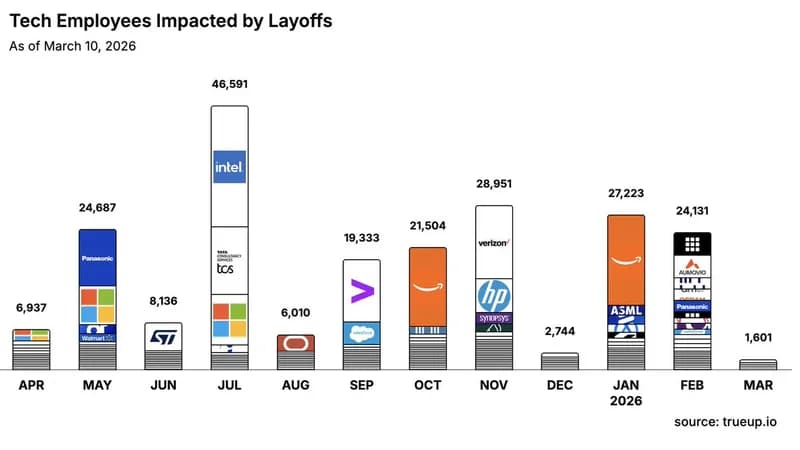
Headlines screamed about AI layoffs, but the reality was far more nuanced than "AI is killing jobs." Between Q3 2025 and Q1 2026, major tech companies announced roughly 85,000 layoffs that touched AI-adjacent roles. Yet in the same period, AI-specific job postings on LinkedIn grew 32%. Companies didn't cut AI - they restructured around it.
What Got Cut - The Specific Roles
The layoffs followed a clear pattern across the industry:
- Middle management in big tech - Google, Meta, and Amazon flattened reporting layers, eliminating 15-20% of mid-level program managers
- Junior data analysts - BI dashboards powered by AI reduced the need for manual reporting roles by an estimated 40%
- Content and copywriting teams - BuzzFeed, CNET, and dozens of media companies replaced editorial staff with AI-assisted workflows
- QA testers - AI-driven test automation cut manual QA teams by 30% at companies like Salesforce and SAP
- Customer support tiers 1-2 - Zendesk and Intercom reported clients reducing human agents by 50% after deploying AI chatbots
What Got Hired - The Counter-Trend
The same companies cutting legacy roles were aggressively hiring for a new class of positions:
- AI Integration Specialists - connecting AI tools to existing business systems ($120K-$170K)
- ML Engineers / MLOps - building and maintaining production AI pipelines ($150K-$220K)
- AI-augmented content strategists - managing AI-human content workflows
- Prompt architects - designing enterprise prompt systems at scale
- Skilled tradespeople - electricians, HVAC techs, and construction workers to build the data centers and infrastructure AI requires
Company-Level Case Studies
Meta
Cut 10,000 roles in early 2026, then posted 4,000 AI-focused positions within 60 days. Net AI headcount actually increased.
Amazon
Reduced warehouse management layers but expanded robotics, AWS AI services, and Alexa LLM teams - hiring 6,000 AI specialists in 2025-2026.
IBM
CEO Arvind Krishna confirmed that 7,800 back-office roles would not be replaced as workers leave - but IBM simultaneously hired 3,000 AI consultants.
Who Bounced Back Fastest
Layoff-to-rehire data from LinkedIn shows a clear hierarchy:
- Fastest (under 30 days): Workers with ML engineering or cloud architecture skills, regardless of which company cut them
- Moderate (30-90 days): Data professionals who pivoted to data engineering or AI implementation roles
- Slowest (90+ days): Generalists without a demonstrable AI project portfolio or domain specialization
What This Means for You
The lesson isn't that AI kills jobs - it's that AI reshapes them, and speed of adaptation determines outcomes. Workers who combined specific, demonstrable AI skills with domain expertise were hired faster, at higher salaries, than before their layoff. Our catalog of 900+ expert-rated courses is built to deliver exactly these targeted, portfolio-building skills - whether you're future-proofing or recovering from a layoff today.