
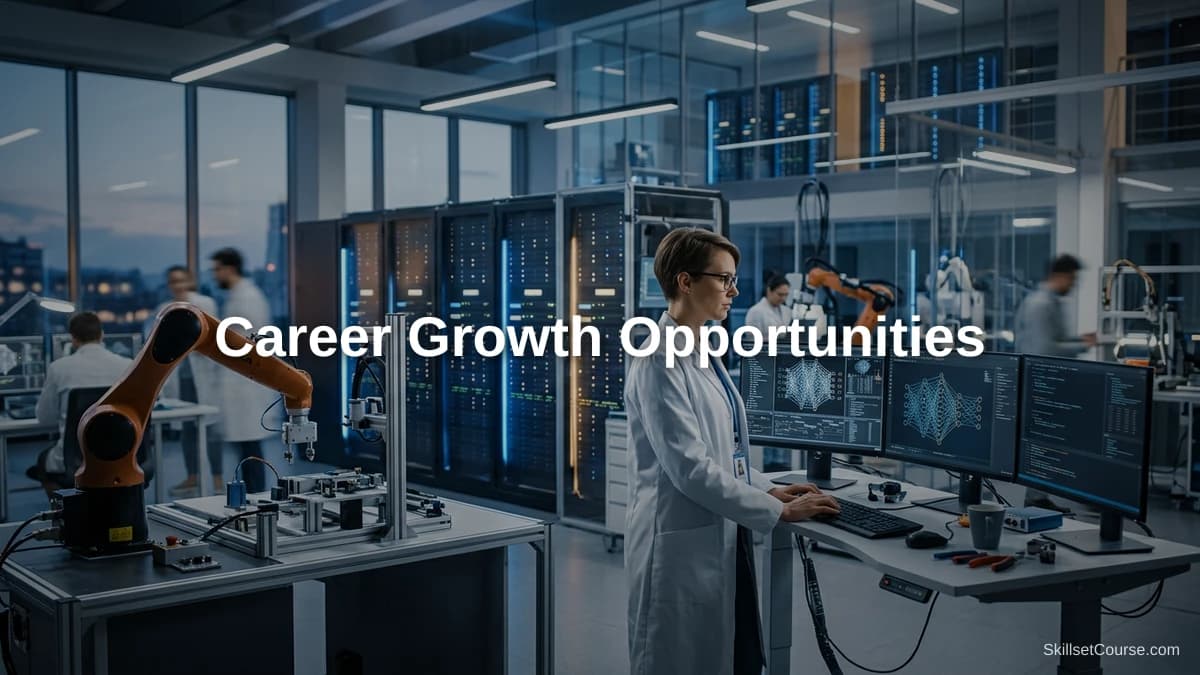
The integration of AI across industries is creating new job opportunities, yet there is a missing rung in the career ladder due to a noticeable skills gap. According to a recent study by the Bureau of Labor Statistics, while AI roles are projected to increase by 34% over the next decade, many professionals face layoffs because they lack the required skills to fill these high-demand positions. This paradox underscores the urgent need to realign skills with market demands.
Key Takeaways
- AI job roles are expected to grow by 34% in the next ten years, according to the Bureau of Labor Statistics.
- Many professionals face layoffs despite these new opportunities due to a skills mismatch.
- Upskilling in AI is essential to bridge the career gap and secure future employment.
- Organizations need to focus on training employees to meet new AI demands.
- Skillsetcourse.com offers targeted courses to help professionals gain necessary AI competencies.
How Can Professionals Bridge the AI Skills Gap?
Understanding the Skills Shortage
The rapid demand for AI professionals has outpaced the current talent pool, creating a widening skills gap. This discrepancy between the number of available roles and qualified candidates presents a significant barrier. According to LinkedIn's 2023 Workplace Learning Report, 71% of learning and development professionals state that the skills gap poses a major challenge.
Despite thousands of vacancies, the skills deficit prevents many from taking advantage of lucrative positions. The need for technical expertise such as machine learning, data analysis, and algorithmic development outlines a new frontier that professionals must conquer.
Embracing Continuing Education
To address the mismatch, continued education and training are imperative. Online platforms such as AI Class courses on skillsetcourse.com offer robust curriculum that covers critical skills from basic AI concepts to advanced machine learning techniques. This ensures accessibility for varied learning needs.
A structured learning path coupled with hands-on projects and peer collaboration enhances practical understanding. According to a survey by IBM, employees who engage in continuous learning report a 42% higher job satisfaction rate, underscoring the value of ongoing skill enhancement.
Role of Employers in Skill Development
Organizations must also play a pivotal role in upskilling their workforce. Investing in training programs tailored to modern job requirements could mitigate the talent shortage. Companies like Amazon and Google have already initiated reskill programs which show promising results.
The World Economic Forum estimates that 50% of all employees will need reskilling by 2025. Employers who prioritize workforce education not only contribute to employability but also ensure business sustainability amid technological advances.
Leveraging Advanced Certifications
The demand for advanced AI certifications is soaring as they validate an individual's expertise in specialized areas. Certifications such as those in machine learning and data science can significantly boost employability. According to a Glassdoor report, professionals with AI certifications can earn up to $125,000 annually, which highlights the lucrative nature of these roles.
Furthermore, structured certification programs on platforms like skillsetcourse.com enable professionals to complete career-relevant projects, providing a competitive edge. This gives learners practical experience that is critical when transitioning into AI-focused roles.
What Sectors See the Most AI Growth?
Technology and Software Development
It's no surprise that the tech industry leads in AI adoption, with roles in software development, data science, and artificial intelligence engineering seeing robust growth. The global machine learning market is anticipated to reach $30.6 billion by 2024, as reported by Statista.
As more companies incorporate AI into their operations, the demand for software developers adept in AI technologies continues to escalate. Mastery in languages such as Python, R, and TensorFlow is particularly desired, and courses from the AI Class courses offer structured resources to acquire these competencies.
Healthcare Innovation
The healthcare industry stands to benefit significantly from AI, with its ability to analyze complex medical data and empower precise decision-making. For instance, AI in healthcare can streamline diagnostics and patient management. The Accenture Institute for High Performance forecasts AI applications in healthcare could save $150 billion annually by 2026.
Professionals in healthcare can capitalize on this trend by learning AI applications specific to their field, such as predictive analytics and robotic process automation - both available via the Alternative Trades health courses on skillsetcourse.com.
Financial Services
AI-driven tools in finance aid in fraud detection, investment strategies, and customer service automation. A report by Deloitte indicates that 86% of financial institutions have implemented AI technologies in some form. The impact is profound, with AI expected to generate $1 trillion in additional value per year through improved efficiencies and new business opportunities by 2030.
Financial professionals can enhance their competitive edge by gaining expertise in AI-driven data analysis and fintech innovations. Endorsing this, our AI Class courses provide comprehensive modules on AI applications in finance tailored to practical industry needs.
Manufacturing and Industrial Automation
The manufacturing sector is undergoing a transformation with the adoption of AI and robotics automation. Automated systems, predictive maintenance, and smart logistics are transforming how manufacturing operations are conducted. A report by McKinsey & Company estimates that AI can increase productivity by up to 20% in manufacturing by optimizing processes and reducing downtime.
Professionals looking to shift into this sector must focus on skills such as robotics process automation and smart factory solutions, which are integral parts of our Robotics program. By acquiring these skills, individuals can secure positions with higher salary prospects and job stability.
What This Means for Your Career
- Take proactive steps toward learning AI fundamentals to align with emerging market demands.
- Identify and fill specific skills gaps by engaging in specialized, role-specific AI training programs.
- Leverage your existing field knowledge by coupling it with AI expertise to secure a competitive advantage.
- Consider cross-disciplinary roles that combine your current skills with AI capabilities for broader career opportunities.
Frequently Asked Questions
What roles are most impacted by AI technology?
Roles in software development, data science, healthcare, and financial services are most impacted by AI advancements. These sectors see a heightened demand for skilled professionals knowledgeable in AI and machine learning tools. Realignment of skills to these roles is imperative for career growth.
How can I start learning about AI?
Begin by enrolling in introductory courses that cover fundamental AI concepts, then progress to more advanced topics in machine learning and data analysis. Skillsetcourse.com offers a diverse range of AI Class courses to suit various learning paths and career objectives.
What is the future employment outlook for AI-related jobs?
The employment outlook for AI-related jobs is highly favorable, with roles expected to grow by 34% over the next decade. The explosive growth in demand for AI-skilled professionals across multiple sectors underscores the importance of upskilling in this area to capitalize on new opportunities.
Are AI jobs replaced by automation?
While automation impacts some roles, AI also creates new job categories, especially in fields requiring human oversight for creative problem-solving. The key lies in upskilling to manage and innovate with AI technologies rather than being replaced by them.
The Bottom Line
AI is reshaping the job landscape with enormous potential for growth. Yet, the current skills gap represents a significant hurdle. To seize the opportunities AI presents, individuals must proactively update their skillsets. Skillsetcourse.com provides a pathway to gaining these essential skills through specialized courses designed to meet industry needs.
Whether stepping into roles within technology, healthcare, finance, or beyond, continuous learning is the linchpin of successful career advancement. Enroll today in AI Class courses to position yourself on the cutting edge of innovation and employment potential.