
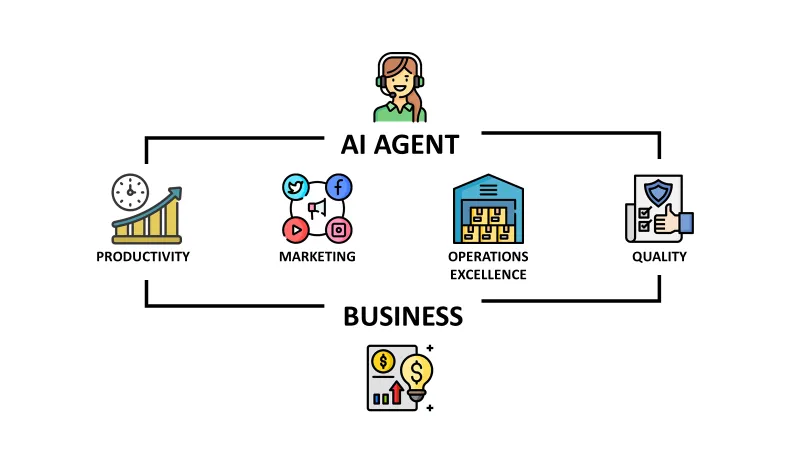
2026 is the year AI agents went from demos to deployments. Companies across every industry are building autonomous systems that can plan, execute, and iterate on multi-step tasks - from customer support to code deployment to financial analysis. Gartner predicts that by 2028, 33% of enterprise software will include agentic AI, up from less than 1% in 2024. The question isn't whether AI agents will transform your workflow - it's whether you'll lead the transformation or be disrupted by it.
What Are AI Agents (and Why Are They Different)?
Unlike simple chatbots that respond to one prompt at a time, AI agents can autonomously plan, use tools, access databases, call APIs, and chain multiple reasoning steps together to accomplish complex goals. The key distinction: agents take actions, not just generate text.
- Tool use - Agents can search the web, query databases, execute code, send emails, and interact with any API
- Memory and state - Agents maintain context across multi-step workflows, remembering what they've done and what's left
- Planning - Advanced agents break complex goals into sub-tasks and dynamically adjust their approach based on results
- Autonomy - Agents operate with varying degrees of independence, from human-in-the-loop approval to fully autonomous execution
Where Agents Are Being Deployed in 2026
Customer Service and Support
Klarna's AI agent handles 2.3 million customer conversations monthly, resolving 66% without human escalation - equivalent to 700 full-time agents. Intercom and Zendesk now offer agent-first architectures where AI handles triage, resolution, and only escalates edge cases.
Software Development
GitHub Copilot Workspace, Cursor, and Devin represent a new category: AI agents that plan, code, test, and iterate on software tasks. They handle boilerplate, code review, bug reproduction, and test generation - letting human developers focus on architecture and design decisions.
Sales and Marketing
AI agents qualify leads, personalize outreach sequences, schedule meetings, and generate campaign analytics. Tools like Apollo.io and HubSpot AI report 3-5x improvements in sales development rep productivity.
Finance and Operations
Agent-based systems at JPMorgan and Goldman Sachs automate report generation, compliance monitoring, and trade settlement. Supply chain agents at Amazon and Walmart optimize inventory routing across thousands of warehouses in real-time.
Internal IT and HR
ServiceNow and Workday embed AI agents that handle employee onboarding, IT ticket resolution, benefits inquiries, and policy lookups - reducing HR and IT support load by 40-60%.
Enterprise Deployment Patterns
Companies deploying agents at scale follow three common patterns:
- Copilot pattern - AI assists a human worker, suggesting actions but requiring approval. Lowest risk, easiest adoption. Example: AI drafts customer replies that reps review before sending.
- Autopilot pattern - AI handles routine tasks fully autonomously, escalating only exceptions. Medium risk. Example: automated invoice processing with human review for flagged anomalies.
- Orchestrator pattern - AI coordinates multiple agents and human workers in complex workflows. Highest complexity. Example: a research agent, analysis agent, and reporting agent collaborating on quarterly market reports.
Skills You Need to Lead (Not Follow)
Building and managing AI agents requires a distinct skill set that combines software engineering with AI-specific knowledge:
- LLM orchestration - Frameworks like LangGraph, CrewAI, and AutoGen for building agent pipelines
- Tool use and function calling - Designing reliable tool interfaces that agents can invoke safely
- Evaluation and testing - Building test suites that measure agent reliability, accuracy, and safety across thousands of scenarios
- Safety guardrails - Implementing authorization boundaries, content filtering, and human-in-the-loop checkpoints
- Monitoring and observability - Tracking agent decisions, costs, latency, and failure modes in production
Get Ahead of the Agent Revolution
AI agents are the most transformative technology shift since mobile apps - and the window to become an early expert is right now. Within two years, agent development skills will be expected rather than exceptional. Our catalog of 900+ expert-rated courses includes dedicated AI agent tracks covering orchestration frameworks, deployment patterns, evaluation, and safety - so you can lead the revolution instead of being disrupted by it.