
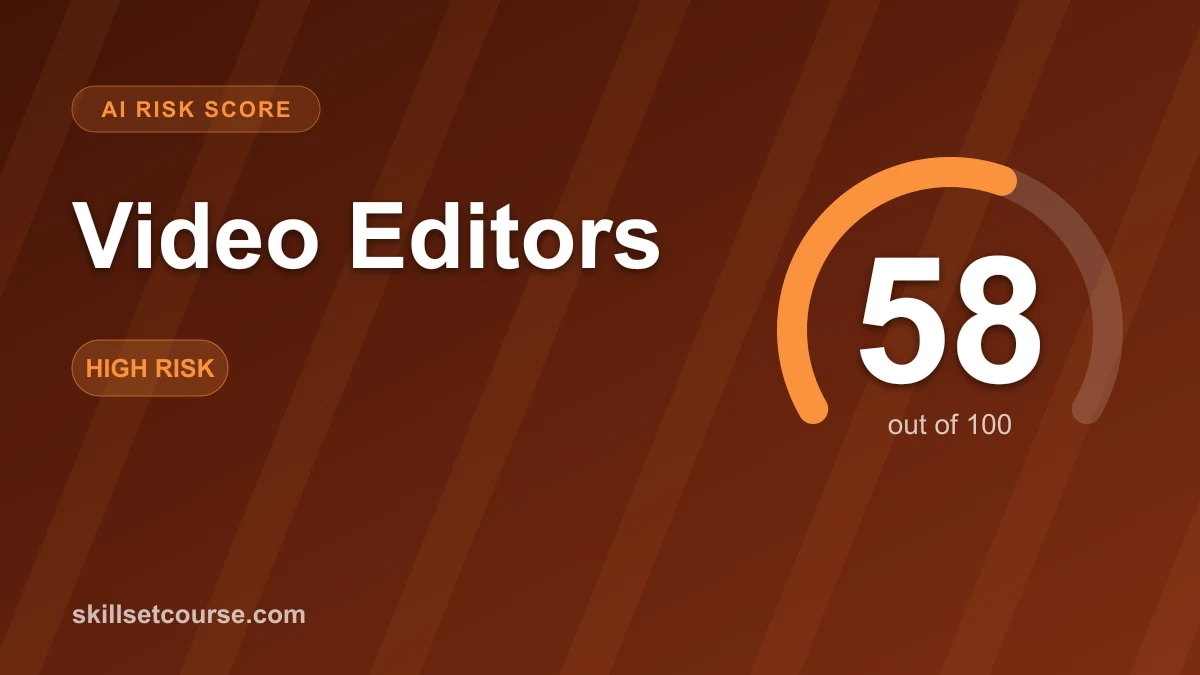
What is the AI risk score for Video Editors?
Video Editors have a high AI risk score of 58/100. This score reflects the significant automation risk from generative video editing technologies, with a 50-65% probability of automating editing tasks. However, human-led complex creative editing remains less susceptible.
Video Editors have a high AI risk score of 58/100. This score reflects the increasing impact of generative AI technologies in the video editing landscape. AI tools like Adobe Premiere Pro's Sensei and RunwayML significantly contribute to this risk by automating parts of the editing process, particularly routine tasks. The task automation probability for generative video editing and asset production is estimated to be between 50-65%, according to current projections. Additionally, the ability of AI to handle tasks like color correction, video stabilization, and asset sorting makes them more susceptible to automation.
However, despite these technological advancements, not every aspect of video editing is equally at risk. High-level creative tasks such as conceptual storytelling and complex scene composition remain primarily human-driven with a lower automation probability of 10-20%. These tasks require unique human insights and nuanced decision-making that current AI models like Midjourney or DeepMind's products are yet to replicate with the same sophistication. Furthermore, while AI can automate many technical aspects, the overall creative process still thrives on human ingenuity, emotion, and intuition, underscoring the enduring importance of human editors.
For video editors exploring ways to adapt, Skillset Course offers pathways for creatives to integrate AI into their skill set effectively. Consider browsing options on the Skillset Course Finder to explore how you can enhance your expertise in AI-supported video editing and maintain a competitive edge in this evolving field.
Which Video Editing tasks are most and least automatable?
Video Editing tasks like generative asset production (50-65%) and basic editing routines are highly automatable, while complex storytelling and creative decisions have a lower automation probability of 10-20%, ultimately requiring human insight and nuance.
The landscape of video editing is markedly transformed by AI, with some tasks in the field highly susceptible to automation, while others remain firmly in the domain of human creativity. Tasks such as generative asset production and basic editing routines are highly automatable. AI tools like DaVinci Resolve's Neural Engine and Adobe's Auto Reframe reduce the need for human input in these areas, reflecting an automation probability of 50-65% for straightforward editing tasks.
Most and Least Automatable Video Editing Tasks
While AI readily automates mundane editing processes, more complex human-centric tasks are less so. Complex storytelling and creative decision-making tasks are likely to remain predominantly human for the foreseeable future, with automation probability estimated at 10-20%.
| Task | Automation Probability | Verdict |
|---|---|---|
| Generative Asset Production | 50-65% | Highly Automatable |
| Basic Editing Routines | 50-65% | Highly Automatable |
| Creative Storytelling | 10-20% | Less Automatable |
| Complex Scene Composition | 10-20% | Less Automatable |
For a comprehensive discussion on AI's impact on different video editing tasks, our Robotics Impact Analysis offers detailed insights into which tasks are more secure against automation. Consider exploring our resources to fortify your skills in areas AI cannot easily replicate.
How is the Video Editor role changing with AI?
The role of Video Editors is evolving as AI handles repetitive and routine editing aspects, enabling professionals to focus on creative decisions, conceptualization, and intricate storytelling, making human input more critical yet less about execution details.
The role of Video Editors is evolving due to advancements in AI technologies. AI handles routine, repetitive aspects of video editing such as simple cuts, color grading, and template-based tasks, freeing editors to focus on more strategic and creative aspects. Tools like Apple's Final Cut Pro X and Frame.io integrate AI features to streamline workflows, allowing professional editors to dedicate more time to creative tasks like conceptualization and narrative storytelling.
Video editing professionals are finding that their skills are being augmented, not replaced, by AI. The new landscape requires them to adapt by mastering AI tools to stay competitive. By focusing on creative decisions and embracing AI for routine work, editors can elevate the overall quality of their projects. Online platforms such as Skillset's Course Finder can assist in locating relevant AI courses tailored to video editing professionals looking to expand their expertise. This shift means human video editors must navigate a hybrid role-managing AI's capabilities while harnessing their creative strengths.
Additionally, the need for continuous learning is paramount. Engaging with platforms like Coursera, Udemy, and LinkedIn Learning helps editors refine their skill set to include AI proficiency, which can lead to a skill premium as high as $15K-25K with expertise in machine learning or AI basics. This trend underscores the importance of creative human input, suggesting a renewed focus on narrative and artistic skills, potentially leading to significant opportunities for those who embrace and adapt to this change.
Which AI tools should Video Editors master now?
Video Editors should become proficient in tools like Adobe Sensei for predictive editing, RunwayML for generative video, and Lektrik for AI-driven workflows, staying competitive by enhancing creative processes through AI integration.
Video Editors can future-proof their careers by mastering a select range of AI tools designed for their industry. Adobe Sensei is instrumental in predictive editing, assisting editors in automating repetitive tasks and predicting cuts based on previous editing patterns. This can significantly speed up the post-production process, allowing editors to focus more on creative storytelling. Generative video editing with RunwayML offers Video Editors the ability to create realistic video effects and animations through machine learning, providing a seamless avenue to enhance creative output with AI-driven enhancements.
Embracing AI-driven Workflows
Tools like Lektrik introduce AI-driven workflows that empower editors to automate asset organization and management. By seamlessly integrating AI tools into their workflow, Video Editors can elevate their efficiency and maintain a competitive edge in a rapidly evolving industry. Mastering these tools not only increases proficiency in handling complex projects but also positions Video Editors as forward-thinking professionals capable of leveraging technology to push creative boundaries.
For those considering deepening their AI skills, platforms like Coursera and LinkedIn Learning offer courses on AI integration in video editing. Pursuing specialized learning can help Video Editors adapt to an industry where AI-assisted editing is increasingly becoming the norm. Explore more options on /class and /decide to find suitable courses that cater to Video Editors looking to expand their AI expertise.
Which skills are rising and losing value for Video Editors?
Skills in AI tool mastery and creative conceptualization are gaining value, while basic editing and routine asset production are declining. Mastering AI-enhanced workflows offers Video Editors a significant career advantage.
In the evolving landscape of video editing, specific skill sets are gaining prominence while others are losing their edge due to AI capabilities. Skills in creative conceptualization and mastery of AI tools for video editing are among the top competencies rising in value. Video Editors who excel in identifying unique storytelling angles while utilizing AI for sophisticated effects stand to gain immensely in this digital age. Creative storytelling remains an essential skill that AI cannot replicate, making it a significant differentiator in a competitive market.
Declining Value of Basic Editing Skills
Conversely, basic video editing and routine asset production skills are witnessing a decrease in demand, as these tasks can be efficiently handled by AI tools. Video Editors who rely solely on traditional editing skills may find their roles increasingly automated, reducing the need for human intervention in these areas.
Video Editors are advised to stay abreast of changes and continuously refine their skills in AI-enhanced workflows to remain relevant. Courses on AI video production available on platforms like Udemy or edX can aid editors in navigating this transition. Visit /robo for insights into automating routine tasks successfully and explore /expert for expert guidance in AI integration.
What realistic career pivots exist for Video Editors?
Video Editors can pivot to roles in virtual production, animation, or creative consulting. These fields demand storytelling expertise, creativity, and technical know-how, making them more resilient to automation by combining innovative concept work with emerging tech.
Video Editors facing the risk of automation can explore realistic career pivots that leverage their existing skills while embracing technological evolutions. Virtual production offers a promising path, combining video editing expertise with real-time effects and virtual sets. This field requires proficiency in using AI-powered tools for live environment generation, making it a resilient choice as it blends creativity with technology.
Animation and Creative Consulting Opportunities
Animation is another viable area where Video Editors can transition, focusing on intricate aspects of motion graphics that demand creative input beyond what AI can offer. Creative consulting is similarly appealing, requiring deep understanding and innovative storytelling capabilities that are resistant to automation. These sectors capitalize on the inherent human creativity in conceptualization and narrative expertise, providing a stronghold against AI replacement.
Video Editors interested in these career pivots can explore courses on animation and creative consulting. DataCamp and Google Skillshop offer valuable resources to adapt skills for these emerging roles. Review your options on /alternative for aligning your career path with technological advancements.
Frequently asked questions
Is AI replacing Video Editing jobs?
AI is prominent in automating routine Video Editing tasks, but complete job replacement isn't imminent. Creative and complex editing efforts remain reliant on human skill.
What 3 jobs will not be replaced by AI?
Jobs requiring deep creativity, empathy, and complex problem-solving-like artists, therapists, and strategic business consultants-are less likely to be replaced by AI.
Which 5 jobs will survive AI?
Jobs that combine empathy, creativity, and strategic skills-such as healthcare professionals, artists, educators, executives, and skilled trades-are expected to survive AI advancements.
Can AI beat Video Editors?
AI can outperform Video Editors in speed for repetitive tasks, but lacks the creative intuition for storytelling and concept ideation, ensuring human editors remain vital.
What is the future of video editing with AI?
The future of video editing will be characterized by AI handling repetitive tasks, freeing editors for creative roles that emphasize storytelling, innovation, and artistic intuition.
Can Video Editing be a career?
Yes, Video Editing remains a viable career. While AI automates aspects, the need for creativity and narrative development ensures ongoing demand for skilled human editors.
The bottom line
Video Editors are facing a high risk of automation, with a benchmark AI Risk Score of 58/100. This reality underscores the importance of embracing AI tools, enhancing creative conceptualization, and considering skill pivots into adjacent roles such as virtual production and creative consulting. The single most crucial action Video Editors can take now is to invest in AI literacy and training. This approach not only safeguards their current positions but also opens doors to innovative career paths that embrace the future of video production. Explore tailored learning opportunities and integrate AI into your workflow to maintain relevance and drive your career forward.