
What is the AI risk for UX Designers?
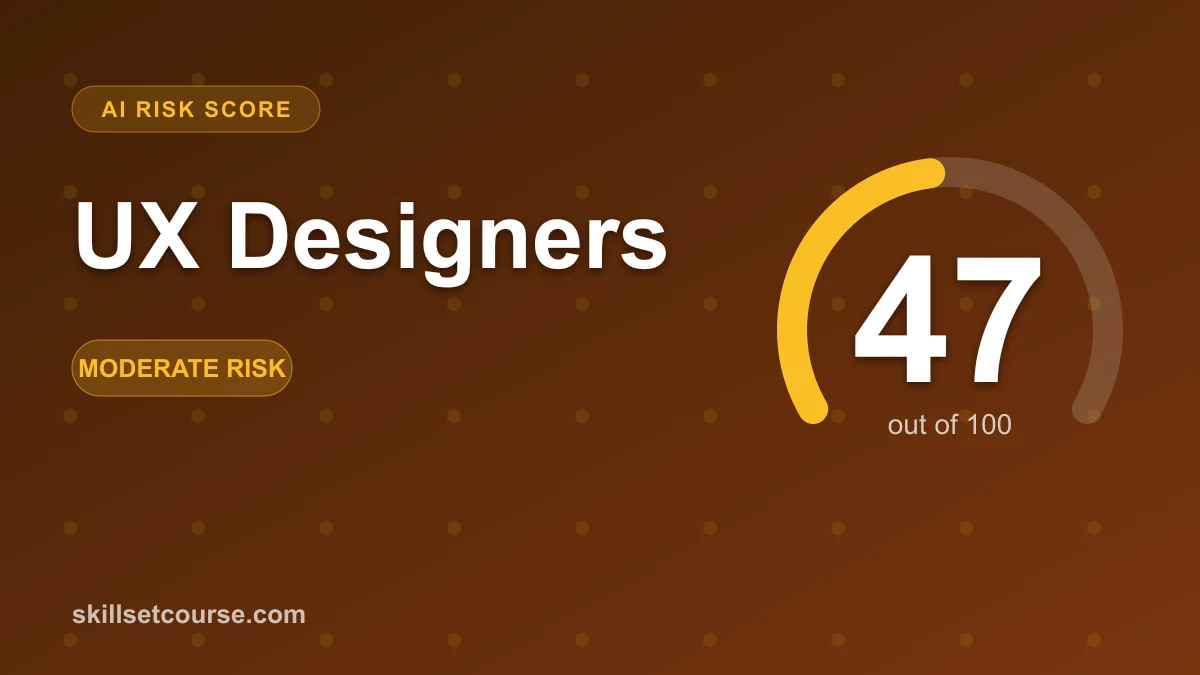
UX Designers have a moderate AI risk score of 47/100. While AI can automate some tasks like research and synthesis (60-75%), the essential creative and empathic aspects of UX design keep this role relatively resilient against AI takeover.
UX Designers hold a moderate AI risk score of 47/100, a reflection of both the opportunities and challenges posed by AI technology within the industry. The primary concern lies in tasks such as research and synthesis, which have a 60-75% probability of automation. Tools like Otter.ai assist in transcribing user interviews and summarizing data, making research processes more efficient. Despite this, the core of UX Design remains deeply human-centered, involving empathic understanding and creativity that AI has not yet mastered.
Creative and Empathic Tasks
One of the aspects that help mitigate the impact of AI on UX Designers is the creative and empathic nature of many design processes, such as developing user personas and creating storyboards. These tasks require nuanced understanding and innovative thinking, areas where AI presently cannot compete. This inherent creativity ensures UX Designers will continue to play a pivotal role in crafting user experiences that truly connect with users on a personal level.
For those considering a career in UX Design or looking to enhance their AI-proof career, understanding the balance between leveraging AI tools and maintaining human-centric design is critical. Explore courses and training that reinforce this balance at Skillset Course.
Which UX Design tasks are most vs least automatable?
Research and synthesis tasks in UX Design, with a 60-75% automation probability, are highly automatable. However, tasks requiring creativity and complex problem-solving, such as crafting engaging user experiences and designing intuitive interfaces, have a much lower automation probability of 5-15%.
Automation in UX Design is uneven, affecting some tasks more than others. Research and synthesis appear to have the highest probability of AI automation, ranging from 60-75%. This is due to advances in AI-driven insights and analytics tools that can quickly process and interpret large datasets. However, tasks that require creativity and human intuition, such as crafting engaging user journeys or designing intuitive interfaces, possess a much lower automation probability of 5-15%.
Task Automation Analysis
Understanding which tasks are most susceptible to automation is crucial for UX Designers aiming to future-proof their skills. The following table outlines tasks within UX Design, their automation probabilities, and a verdict on their AI risk:
| Task | Automation Probability | Verdict |
|---|---|---|
| Research and Synthesis | 60-75% | High |
| Designing Intuitive Interfaces | 5-15% | Low |
| Prototyping | 30-45% | Moderate |
The table illustrates the variability in automation potential across tasks. As AI continues to evolve, UX Designers need to continually update their skills to stay relevant, potentially by learning new tools and methods provided by platforms such as Skillset Course.
How is the day-to-day role of UX Designers changing?
AI tools are transforming UX Designers' roles by taking over repetitive tasks like user data analysis, enabling designers to focus more on strategic planning, creative innovation, and empathetic design, reinforcing the human-centric aspect of their work.
The advent of AI is reshaping the daily activities of UX Designers, primarily by automating repetitive tasks such as user data analysis. AI tools like Notion AI and AI-driven prototypes contribute to the efficiency and speed of workflow processes, allowing designers to dedicate more time to higher-level tasks like strategic planning and creative design.
Shift to Strategic Planning and Innovation
With AI handling tasks like data interpretation, UX Designers can focus on strategic components of their role. Designing for user empathy and crafting innovative solutions that address real-world problems are now at the forefront. Consequently, UX Designers are becoming more involved in cross-functional teams, emphasizing the importance of a holistic understanding of both design principles and business objectives.
- Invest time in continuous learning about the latest AI tools, potentially via Skillset Course offerings.
- Embrace interdisciplinary collaboration as a way to enhance user experience outcomes.
- Leverage AI to test and refine design hypotheses quickly, optimizing user interaction and engagement.
As AI continues to evolve, UX Designers will need to balance their technical abilities with creative insights to remain indispensable. For those seeking growth in this dynamic environment, developing a strategic learning stack could be immensely beneficial.
Which AI tools should UX Designers master now?
UX Designers should master AI tools such as ChatGPT for ideation support, Notion AI for project management, and Figma's AI features to enhance their design workflows, thus staying competitive and elevating design creativity and efficiency.
UX Designers in 2025-2026 should strategically incorporate AI tools into their workflows to remain competitive and efficient. ChatGPT is increasingly popular for ideation support, assisting designers in brainstorming sessions by generating diverse user scenarios and solutions based on user prompts. This tool helps UX Designers break out of creative ruts and think outside the box. Similarly, Figma's AI features enhance design workflows by automating routine tasks such as resizing and color adjustments, freeing designers to focus on more complex creative elements. By leveraging AI for ideation and automation, designers can reduce time spent on repetitive tasks and enhance their creative output, staying ahead of the curve.
Notion AI contributes significantly to project management by organizing and prioritizing tasks, especially in multidisciplinary teams where UX Designers coordinate with developers and product managers. With tools like Notion AI, tracking design iterations and gathering feedback becomes streamlined, allowing for more iterative and user-focused design processes. As industry AI adoption increases, mastering these tools helps UX Designers unlock new career advancements, potentially leading to new role creation or hybrid roles that integrate design with AI-driven strategies.
Adaptation and continuous learning through online platforms such as Coursera and LinkedIn Learning is crucial for mastering these tools. UX Designers can utilize these platforms to stay updated on the latest AI tools and methodologies, ensuring their skills remain relevant in an evolving market. Explore opportunities on Skillset Course to find courses that enhance your AI proficiency in UX design.
Which skills are rising vs losing value for UX Designers?
AI and machine learning basics are rising in value, offering salary premiums of $15-25K. Meanwhile, routine tasks such as standard document drafting, losing value to AI automation, underscore the need for emphasizing strategic and creative skill sets in UX Design.
In the field of UX Design, understanding which skills are gaining or losing value is critical for future success. As AI integration increases, skills such as machine learning and AI basics are climbing in value. By enhancing their knowledge of these areas, UX Designers can potentially see salary premiums between $15,000 to $25,000. These skills open the door to creating more intelligent, adaptive, and user-centered design frameworks.
Conversely, routine tasks like standard document drafting are becoming automated, diminishing their value in the UX Designer's skill set. As a result, designers should prioritize strategic planning, complex problem-solving, and human-centered design approaches. Creativity and strategic innovation are less susceptible to automation, making them essential for UX Designers seeking to future-proof their careers.
As routine tasks diminish, the emphasis on strategic creativity strengthens. UX Designers should consistently improve strategic planning and innovation abilities, such as learning how to apply AI insights to design challenges. Having a solid understanding of human behavior and empathy-driven design remains invaluable, as these qualities are challenging for AI to replicate. For guidance on optimizing your learning strategy, visit our Course Finder for tailored skill-building pathways.
What are realistic adjacent pivots for UX Designers?
UX Designers can pivot to roles like UX Research or Human-Centered Design, which remain more resilient due to their focus on human interaction and innovative problem-solving. These roles require less automatable skill sets and focus on understanding user needs.
UX Designers exploring career pivots can transition into roles that emphasize human interaction and complex problem-solving. UX Research and Human-Centered Design are such roles, thanks to their reliance on understanding nuanced user behaviors and needs. These areas are less automatable due to their complexity and personalized nature, making them resilient options in the AI era.
UX Research involves deep dives into user analysis, dissecting how products fit within user lifestyles and identifying potential areas for innovation. This role continues to demand high-level empathy and creative synthesis skills, which are challenging for AI to fully automate. Human-Centered Design, meanwhile, focuses on tailoring solutions that resonate deeply across user demographics, blending intuitive design with emotionally intelligent strategies.
Pivoting into these areas may require additional coursework and skill-building in specific research methodologies and design thinking frameworks. Online platforms like Udemy and DataCamp offer courses to help UX Designers become proficient in these resilient areas, equipping them with the expertise needed to thrive in roles emphasizing empathy and innovation. For a comprehensive overview of courses to support your transition, explore our Skillset Course resources for every career stage.
What if your job title is different?
The same AI Risk Score applies across the common job titles for this work. UX Designers are also called User Experience Designers, UI/UX Designers, Interaction Designers, Experience Designers.
Will AI replace ui/ux designers?
ui/ux designers fall under the ux designers analysis on this page, with an estimated AI Risk Score of 47/100 (Moderate risk). The main driver is the same: research and synthesis (60-75%). Read the task-level breakdown above to see which parts of the job are exposed.
Will AI replace ui ux designers?
ui ux designers fall under the ux designers analysis on this page, with an estimated AI Risk Score of 47/100 (Moderate risk). The main driver is the same: research and synthesis (60-75%). Read the task-level breakdown above to see which parts of the job are exposed.
Roles that are often confused with this one
- Visual Designers.
- Graphic Designers.
- Product Managers.
Frequently asked questions
What impact does AI have on UX Designers?
AI impacts UX Designers by automating research tasks, allowing them to focus on creativity and strategic planning. It shifts the emphasis from routine tasks towards human-centric design challenges that require empathy and innovation.
Are UX Designers in demand despite AI?
Yes, UX Designers are still in demand as their creative and human-centric skills are crucial and less prone to automation, preserving their relevance in technology-driven enterprises.
What percentage of UX Design tasks can AI automate?
AI can automate around 60-75% of UX Design tasks related to research and synthesis, but creative and interpersonal elements of the role have much lower automation probabilities.
Can AI fully replace UX Designers?
AI cannot fully replace UX Designers due to the necessity of human-centered and empathic design, which AI currently struggles to replicate, hence preserving the integral human elements of the role.
How can UX Designers future-proof their career against AI?
UX Designers can future-proof their careers by mastering AI tools, enhancing their creative and strategic skills, and focusing on innovative user experiences, thus aligning themselves with industry trends.
What courses can help UX Designers adapt to AI?
Courses on AI and machine learning fundamentals on platforms like Coursera or Udemy can aid UX Designers in adapting to AI trends, offering essential knowledge and skills to remain competitive.
The bottom line
For UX Designers in 2025-2026, adapting to AI advancements while honing strategic and creative skills can significantly impact career longevity and success. With an AI Risk Score of 47, the emphasis is on understanding AI's role in design and leveraging it to enhance creativity and efficiency. By mastering AI tools and refining high-impact design abilities, designers can mitigate automation risks while opening avenues for growth. The most critical action now is to continuously integrate AI-focused learning as part of your professional development, ensuring adaptability and relevance as the industry evolves. Consider engaging with targeted AI and UX courses available on platforms like DeepLearning.AI and Skillset Course.