
Will AI replace Photographers?
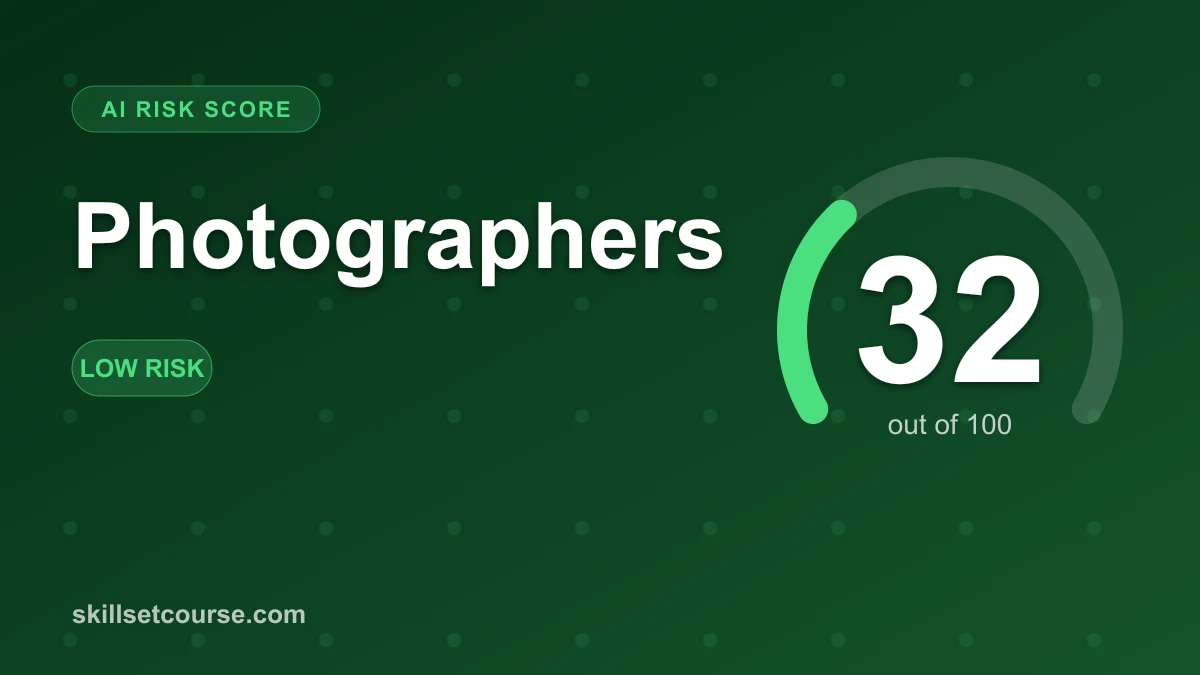
Photographers face a low risk of AI replacement. With a benchmark AI risk score of 32/100, generative image production automation is 20-35%. The creativity and human elements are still vital and hard for AI to replicate.
Photographers face a low risk of AI replacement, maintaining an AI risk score of 32 out of 100 on the Skillset Course benchmark. The core of a Photographer's work-creativity, human interaction, and capturing authentic moments-remains less susceptible to automation. While generative image production technologies have the potential to automate some aspects of the job, contributing to an automation probability of 20-35%, these tools enhance creativity, allowing Photographers to blend traditional photography with AI-driven innovation.
The human element inherent in capturing moments of emotional and cultural significance is not easily replicable by AI. Technologies like OpenAI's DALL-E support artistic exploration but cannot replace the Photographer's intuition and personal touch. Additionally, Photographers often serve in roles that require direct client interaction, such as understanding client needs and guiding them through the creative process, which AI lacks the emotional intelligence to replicate accurately. This reinforces the importance of soft skills such as communication and collaboration, crucial in working with clients to achieve desired outcomes.
For individuals seeking to future-proof their careers, developing skills in AI-enabled tools can add value. Courses on platforms like Coursera and LinkedIn Learning can help enhance understanding of emerging technologies. Visit our Decide Hub to explore career strategies that integrate AI effectively without losing the essential human touch.
Which tasks are most automatable for Photographers?
For Photographers, tasks like basic image editing (65-80%) and generative asset production (20-35%) have higher automation probabilities. However, tasks requiring creative vision and personal interaction remain largely non-automatable.
In the realm of photography, some tasks are more susceptible to automation than others due to advancements in AI technology. Automating specific routine and repetitive tasks allows Photographers to focus on creativity and client-specific needs. High-automation tasks include basic image editing and enhancement processes, which carry an automation probability between 65-80%. AI technologies like Photoshop's Neural Filters assist Photographers in enhancing images efficiently, saving time and effort on routine tasks.
Automation in Photographers' Daily Tasks
| Task | Automation probability | Verdict |
|---|---|---|
| Basic Image Editing | 65-80% | Highly Automatable |
| Generative Image Production | 20-35% | Partially Automatable |
| Creative Vision Development | 5-15% | Non-automatable |
Generative asset production, using AI tools like Midjourney, offers Photographers the ability to expand their creative capabilities but remains partially automatable at a probability of 20-35%. Importantly, the task of developing and executing a creative vision, which involves personal interaction and intuition, is far less automatable at a probability of 5-15%.
For further exploration of AI's role in Photographers' careers, consider our Robo Decision Assistant to guide skill augmentation and tool adoption.
How is the day-to-day role of Photographers changing?
AI tools like Adobe Sensei are changing Photographers' roles by enhancing editing processes and offering creative assistance. This integration allows Photographers to focus more on artistic direction and personal client interaction.
The integration of AI in photography is reshaping how Photographers carry out their day-to-day roles. With AI-driven tools like Adobe Sensei, automation in editing and post-processing allows Photographers to streamline workflows, significantly reducing the time spent on these elements. Photographers can allocate more time and resources to nurturing creative concepts and engaging directly with clients.
AI Enhancements in Photographers' Workflow
- Improved Editing Efficiency: AI technologies streamline processes, enabling quicker turnaround times and enhanced quality in outputs.
- Enhanced Creative Assistance: AI offers suggestive edits and creative guidance, augmenting, but not replacing, the Photographer's vision.
- Client Interaction Focus: Freed from routine tasks, Photographers have more bandwidth to concentrate on personalizing client experiences.
These tools help Photographers maintain artistic integrity while ensuring competitive service delivery. AI's role is evolving into an assistant that supports rather than replaces artistic leadership. As AI technology continues to evolve, understanding its applications in photography becomes crucial. Explore skill-enhancing opportunities through our Class Finder to stay ahead of the curve.
The continued development of such tools foretells a future where Photographers can focus more on the artistic and human dimensions of their craft, using AI as an augmentative force rather than a replacement, aligning with the Expert Insights at Skillset Course.
Which AI tools should Photographers master now?
Photographers should master AI tools like Adobe Sensei for advanced editing and asset generation, and Luminar AI for creative enhancements. Skillset Course recommends focusing on tools aiding creativity rather than replacing it.
Photographers aiming to stay relevant in a landscape increasingly touched by technology should prioritize mastering AI tools that enhance creative workflows rather than replace them. Leading AI tools like Adobe Sensei can transform image editing, offering advanced features that streamline processes traditionally requiring hours of manual work. Sensei’s capabilities include automated tagging, facial recognition, and enhanced image searching, which can save significant time during post-production. Luminar AI, another popular tool, is specifically designed to support creative enhancements. It features templates that adapt to image styles, offering features such as AI sky replacement and intelligent background adjustments that assist photographers in refining their unique artistic vision.
Skillset Course advises photographers to focus on these tools that empower the artistic process rather than those that threaten to make creativity redundant. Engagement with such technologies can allow photographers to explore new dynamics of visual storytelling, ultimately expanding their portfolio and market reach. A balance between these tools and classic photographic techniques is essential. By learning AI-assisted editing, photographers can enrich their composition skills alongside AI’s rule-based adjustments. To explore the evolving photographic landscape, photographers can visit our expert page for further insights and connect with communities embracing AI’s potential.
Which skills are rising vs losing value for Photographers?
Rising skills for Photographers include AI-assisted editing and creative direction. Skills losing value are routine editing and basic image formatting, which are increasingly automated by AI-powered technology.
As AI continues to permeate the world of photography, certain skills are becoming increasingly valuable while others are starting to diminish in importance. Rising skills include proficiency in AI-assisted editing, where technology aids the refinement of images through adaptive learning processes. Photographers with a keen sense of creative direction that incorporates AI’s capabilities will flourish, as these skills allow for greater expression and nuanced storytelling.
Emerging Skills
- AI-assisted editing: Algorithms offer capabilities like auto-enhancements and intelligent filtering.
- Creative direction: Integrating AI helps photographers conceptualize innovative visuals.
- Understanding AI tools: Command over systems like Luminar AI and Adobe Sensei becomes crucial in competitive markets.
Declining Skills
- Routine editing: Tasks like basic touch-ups and color correction are automated, reducing the need for manual input.
- Basic image formatting: These tasks are increasingly handled by AI software, lowering the demand for such expertise.
Photographers should note that the decline of routine editing and basic formatting does not detract from their foundational skills but rather elevates them to apply their talents in more innovative directions. For pathways in mastering these rising skills, consider exploring learning resources and coursework at Skillset Course. Every innovatively edited photo can serve as a unique narrative beacon in the digital ocean.
What are realistic adjacent pivots for Photographers?
Realistic adjacent pivots for Photographers include roles in digital content creation and visual design, where creative skills are complemented by AI tools. These fields offer resilience against AI replacement due to their heavy reliance on human creativity.
For photographers seeking to diversify in their career, realistic adjacent pivots include roles related to digital content creation and visual design. These sectors value creative insights complemented by the capabilities of AI tools. Shifts to these domains allow photographers to leverage their spatial awareness and artistic eye alongside new technologies. Digital content creation often involves constructing sophisticated visual narratives using AI-enhanced techniques, while visual design intersects with elements like graphic design, demanding synergy between human creativity and AI capabilities.
Visual Design Opportunities
- Graphic design: Utilizes AI for tasks such as typography adjustments and color palette selections.
- UI/UX design: Integrates photographic elements with digital interfaces for improved user engagement.
Transitioning to these adjacent fields mitigates the risk associated with AI dominance, as these roles have a slower pace of automation due to their reliance on human creativity. Photographers can capitalize on their strengths while benefiting from AI’s potential in non-traditional roles. For those interested in visual avenues beyond traditional photography, Skillset Course’s alternative pathways offer guidance on blended career trajectories involving creative and technical dimensions. Exploring these paths could lead to enriched job opportunities where AI enhances, not replaces, essential human contributions.
Frequently asked questions
Is AI a threat to photographers?
AI poses a low threat to Photographers since it complements rather than replaces creative and interpersonal skills necessary for effectively capturing unique visual stories.
Which 5 jobs will survive AI?
Jobs in design, healthcare, education, human resources, and art, including Photography, will survive AI due to their reliance on creativity, human judgment, and interaction.
Is it worth being a photographer in 2026?
Yes, it's worth being a Photographer in 2026. Creativity, uniqueness, and interpersonal skills remain essential, with AI acting as a supportive tool to enhance artistic capabilities.
What 3 jobs will not be replaced by AI?
Jobs not likely replaced by AI include Photographers, therapists, and educators, as they demand creativity, empathy, and a human touch, which AI currently lacks.
Has AI killed photography?
AI has not killed Photography but transformed it by providing tools for enhanced editing and creative processes. The core art form and human interaction remain intact.
Will AI replace videographers like photographers?
Similar to Photographers, Videographers face AI integration rather than replacement, enhancing editing and production processes while maintaining creative direction and storytelling.
The bottom line
The benchmark AI risk score of 32/100 signifies a low threat of replacement for photographers by AI. Despite AI enhancing asset production capabilities, human creativity in photography remains irreplaceable. The need for mastering tools like Adobe Sensei and Luminar AI is paramount. Skillset Course suggests prioritizing the understanding of AI tools that assist creativity to maintain relevance and explore new artistic dimensions. Photographers should consider expanding their skillset to include AI-assisted editing, which retains the essence of creativity while allowing more efficient workflow management. Embrace these tools as allies in artistic evolution and catalytic forces for visual storytelling innovation.