
Will AI Replace Graphic Designers?
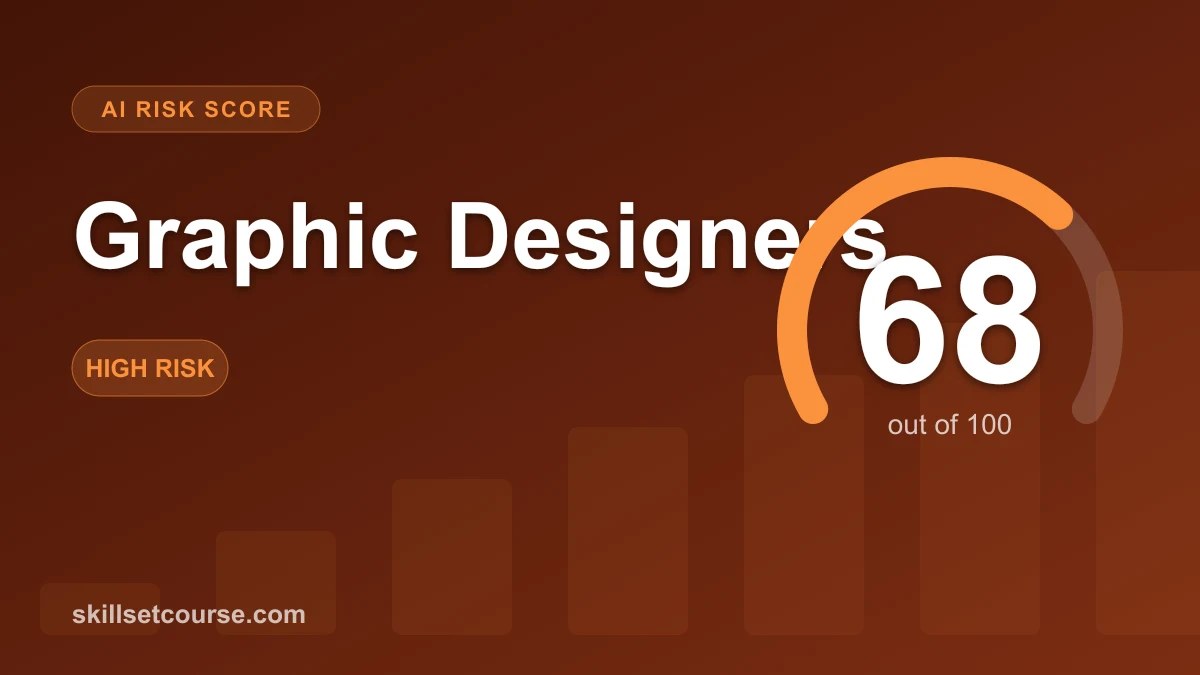
Graphic Designers are at high risk of AI disruption, scoring 68/100 according to our benchmark. This is primarily due to generative image and asset production, automated at a 70-85% probability. The sector must adapt to these technological shifts.
Graphic Designers face a high risk of AI disruption, scoring 68/100 according to the Skillset Course benchmark analysis. This score is primarily driven by the adoption of generative image and asset production technologies. Tools like Adobe Firefly and Midjourney have automated design tasks with a 70-85% probability as they significantly streamline the creation process. For Graphic Designers, adapting to these technological advancements is crucial to remain relevant. The profession is evolving; while AI handles routine design generation efficiently, roles are shifting towards strategic responsibilities that AI cannot fulfill. Graphic Designers must develop skills to navigate these changes, potentially focusing on mastering AI tools or engaging clients with their creative expertise.
The integration of AI requires Graphic Designers to reconsider their value proposition and embrace advanced AI technologies. Skillset Course recommends upskilling with AI-specific learning stacks, including courses focused on tools like DALL-E and Photoshop AI. While these courses do not guarantee employment, they offer competitive advantages. Graphic Designers can explore courses on platforms such as Coursera, LinkedIn Learning, or DeepLearning.AI to enhance their skill set and improve their adaptability in the rapidly-evolving industry.
Given the transformation underway, Graphic Designers can explore options on Skillset Course's AI-professions resource pages such as Career Decide or Alternative Paths to navigate this career landscape effectively.
What Graphic Designer tasks are most vs least automatable?
For Graphic Designers, tasks like basic design generation and pattern recognition are highly automatable, with a 70-85% probability. In contrast, complex client negotiations and novel creative problem-solving remain significantly less automatable at only 5-15%.
Among Graphic Designers, specific tasks have varying degrees of automation likelihood. As AI tools advance, tasks like basic design generation and pattern recognition are becoming increasingly automated, now standing at a 70-85% probability according to Skillset Course estimates. These high automation probabilities result from AI's proficiency in handling structured design processes, using tools such as Canva and Figma AI. However, tasks involving complex client negotiations and novel creative problem-solving remain less susceptible to automation, with a probability of only 5-15%. These tasks require unique human insight, creativity, and empathic client communication, which are beyond AI's current capabilities.
Automation Analysis for Graphic Design Tasks
| Task | Automation Probability | Verdict |
|---|---|---|
| Basic Design Generation | 70-85% | Highly Automatable |
| Pattern Recognition | 70-85% | Highly Automatable |
| Complex Client Negotiations | 5-15% | Low Automatable |
| Novel Creative Problem-Solving | 5-15% | Low Automatable |
Given these dynamics, Graphic Designers must focus on developing skills in high-impact areas less likely to be automated. Upskilling in AI basics or learning new creative tools can offer a skill premium of $10K-$25K over average salaries. For detailed guidance on skill premiums and upskilling pathways, consult Expert Advice pages at Skillset Course.
How is the Graphic Designer role actually changing?
Graphic Designers now integrate AI for routine tasks, shifting their role towards strategic consultation and creative concepting. Generative AI handles repetitive image creation, freeing designers to focus on client-specific creative strategies.
As AI technologies, such as generative design tools, reshape creative fields, the role of Graphic Designers is experiencing significant change. Designers increasingly integrate AI into their workflows for tasks like routine image creation, allowing them to pivot towards more strategic and conceptual responsibilities. Automated design systems, including Adobe Sensei and DeepAI, efficiently handle repetitive creation tasks, thus enabling Graphic Designers to focus on client-specific strategies and creative concepting.
This shift calls for designers to engage as creative consultants, offering strategic input that AI tools cannot replicate. Enhancing human-centric skills like empathy and vision for design strategies is now paramount. Graphic Designers are expected to lead in conceptualizing projects, while AI assists with execution and iteration. This transformation emphasizes the importance of mastering tools like Notion AI for organizational effectiveness and Otter.ai for efficient communication workflows.
Designers considering this evolution should seek resources on Skillset Course's AI-proof Career Classes for advice on adapting to these changes. The career landscape for Graphic Designers will continue to evolve, highlighting the necessity to align skill sets with technological advancements to maintain professional relevance. Understanding this trend can help Graphic Designers optimize their roles for future growth and innovation opportunities.
Which AI tools should Graphic Designers master now?
Graphic Designers should master tools like Adobe Sensei and Canva's AI features, which are rapidly being adopted in 2025-2026 for efficiency and enhanced creativity. Experienced use can enhance design quality and career prospects.
Graphic Designers looking to advance their careers should focus on mastering AI-driven tools to stay competitive in a rapidly evolving industry. Adobe Sensei, integrated within Adobe Creative Suite, offers powerful features for automating routine tasks and enhancing creative possibilities. This AI tool assists with tasks like image editing, video creation, and even UX design, freeing designers from repetitive processes and allowing more time for strategic creativity. Additionally, Canva's AI features are becoming essential, especially for freelance and entry-level designers who need to streamline asset creation. Canva's AI supports user-specific adjustments and suggestions, making designing faster and more intuitive.
According to industry reports, the adoption of tools like these is projected to increase from 30-45% currently to 65-80% by 2026. Mastering these tools not only enhances aesthetic output but also boosts career longevity. Skillset Course recommends leveraging these platforms to sharpen skills that combine creativity with technology, a crucial blend in the modern design landscape. Our Course Finder can help identify courses that include hands-on practice with tools like Adobe Sensei.
Which Graphic Designer skills are rising vs losing value?
Rising Graphic Designer skills include AI tool proficiency and strategic vision, while routine design production is losing value due to automation. Mastering machine learning basics and prompt engineering can offer a salary premium.
The urgency for Graphic Designers to evolve their skillsets is palpable, driven largely by the rising value of AI tool proficiency and strategic vision. As AI displaces traditional design tasks, designers who possess nuanced competencies in machine learning basics and prompt engineering can command salary premiums of up to $25K annually. Creative abilities combined with tech insight will be vital by 2026.
Conversely, routine design production skills are losing prominence. Automated generative design platforms can create standard assets at a fraction of the time it historically took, which minimizes the reliance on designers for such tasks. Thus, designers should invest time in studying AI integration techniques and strategic foresight, which not only preserves their relevance but ensures they remain pivotal in providing creative direction. Skillset Course's Learning Stack promotes retaining valuable insights on market shifts and technology adaptations.
What are realistic adjacent pivots for Graphic Designers?
Graphic Designers can pivot to roles like UX/UI Design or Digital Product Management, both of which focus on high-touch, user-centric tasks resilient to AI. These pivots emphasize strategy and client interaction over routine production.
Graphic Designers possessing a strategic and user-centric aptitude have promising adjacent career paths available, notably in UX/UI Design and Digital Product Management. These roles focus heavily on personalization and user ergonomics, which are areas where AI's impact remains minimal due to the nuanced understanding of human interaction required.
In UX/UI Design, professionals leverage deeper insights concerning user interaction and interface design, often beyond what AI can generate autonomously. Digital Product Management positions require balancing technical specifications with user needs, demanding a refined approach that AI supports rather than replaces. These roles carry with them an expectation of direct engagement with clients and stakeholders. Skillset Course's resources outline pathways and skills pertinent to transitioning into these domains, with a focus on developing strategic competence and customer collaboration.
Frequently asked questions
How soon might AI replace Graphic Designers?
AI's influence on Graphic Designers is expected to grow significantly by 2025-2026, but complete replacement is unlikely soon. Designers who adapt by learning AI tools can secure their roles.
Can AI design better than Graphic Designers?
AI excels at rapid task execution and pattern recognition, often surpassing Graphic Designers in speed. However, it lacks the nuanced creative insight and cultural understanding that human designers offer.
What AI tools are used by Graphic Designers?
Graphic Designers frequently use tools like Adobe Sensei, Canva AI, and DALL-E to enhance their workflows, automating repetitive tasks and expanding creative capabilities.
How can Graphic Designers future-proof their careers against AI?
Graphic Designers should focus on developing creative strategy, AI tool proficiency, and client communication to future-proof their careers. Continuous learning via platforms like Skillset Course is crucial.
Are Graphic Designers earning less due to AI?
While AI can impact earnings in roles focusing solely on routine design tasks, Graphic Designers leveraging AI tools and entering strategic roles report salary premiums, particularly with skill upgrades.
Is learning AI mandatory for all Graphic Designers?
While not mandatory, learning AI is increasingly important for Graphic Designers to stay competitive. Mastery of AI tools can lead to new career opportunities and advancements.
The bottom line
Graphic Designers face a high AI replacement risk-current estimates suggest a 68/100 risk score largely driven by generative asset production capabilities. To thrive amidst this evolution, mastering AI tools like Adobe Sensei and expanding into roles involving strategic foresight will be crucial. Engaging with advanced courses and resources offered by Skillset Course is advised to bolster necessary competencies effectively. The most critical action now is to familiarize oneself with AI-driven tools integral to the design process and enhance one’s strategic ability to maintain relevance in the industry.