
Will AI Replace Animators?
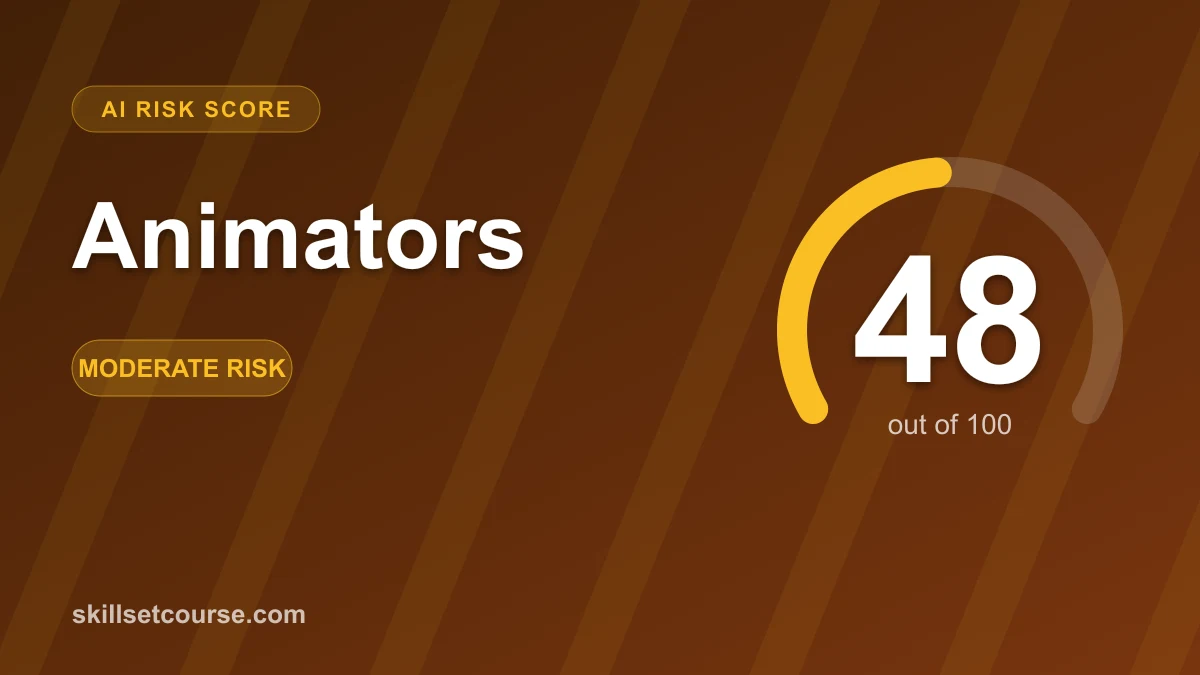
Animators have a moderate 48/100 risk score due to AI-driven generative animation. Technologies can automate 45-60% of asset production tasks but the artistic vision and narrative crafting remain fundamentally human, keeping animators necessary.
Animators have a moderate 48/100 AI risk score due to the capabilities of AI-driven generative animation tools. While AI can automate a significant portion of asset production tasks, estimated at 45-60%, the necessity for artistic vision and narrative crafting remains crucial. This dynamic keeps animators integral to the creative process because AI lacks the nuanced understanding required for storytelling and emotional engagement in animation. Current technologies like OpenAI's DALL-E and NVIDIA's StyleGAN are advancing rapidly, suggesting significant efficiency in generating visual components, yet the creative direction that animators bring cannot be replicated by algorithms.
Generative AI provides animators with tools that can enhance productivity and streamline repetitive processes, such as background rendering and synchronization, freeing them to concentrate more on the artistic aspects of their projects. This synergy between human creativity and machine efficiency allows for a richer creative output. Animators must thus stay informed about AI trends and developments, leveraging platforms like Skillset Course's Course Finder to identify new learning opportunities and expand their technical skill set in conjunction with AI advancements.
In essence, while AI reshapes certain tasks within the animation profession, it cannot wholly replace the core responsibilities that define the animator's role. Understanding how to integrate AI into existing workflows will be vital for animators aiming to maintain relevance and excel in the evolving artistic landscape.
Which Animator Tasks Are Most Versus Least Automatable?
Generative animation AI can automate asset creation tasks at 45-60%, similar to standard document drafting. However, less automatable tasks like storytelling and novel problem-solving, with only a 5-15% probability, keep animators' creative roles secure.
The role of animators is undergoing significant transformation as AI tools automate various tasks within animation. Generative animation AI optimizes asset creation tasks with a 45-60% automation probability, akin to standard document drafting tasks. However, crucial elements like storytelling and novel problem-solving have much lower automation probabilities, ranging between 5-15%, ensuring the security of animators' creative roles. This balance underscores the importance of human creativity in the animation process.
Task Automation Table
| Task | Automation Probability | Verdict |
|---|---|---|
| Asset Creation | 45-60% | Highly Automatable |
| Storytelling | 5-15% | Not Automatable |
| Novel Problem-Solving | 5-15% | Not Automatable |
| Basic Reporting (Animation Progress) | 85-95% | Highly Automatable |
AI tools like Adobe's Sensei and Unity's AI-driven workflows assist animators by enhancing asset production efficiency and speeding up animation cycles. With these technologies, tasks that involve repetitive digital rendering see increased automation as AI systems streamline processes, allowing animators to focus on ensuring artistic coherence and narrative depth within their projects.
To ensure longevity and career growth in this field, animators should invest in understanding and mastering these AI tools. Platforms like Skillset Course provide resources for courses that align with these technological shifts, enabling animators to enhance their skill sets with AI competencies.
How Is the Animator Role Changing Day-to-Day?
Day-to-day, animators increasingly integrate AI for rapid asset creation, shifting focus to creativity and storytelling. AI like Midjourney shapes animation pre-production, but human oversight ensures narrative quality and artistic distinction.
The role of animators is progressively adjusting as AI technologies infiltrate the profession, impacting daily operations. Day-to-day, animators are increasingly incorporating AI tools for rapid asset creation, which shifts their professional focus towards creativity and storytelling. Technologies such as Midjourney AI facilitate efficient pre-production by generating preliminary visual content that serves as a foundation for animators to refine and imbue with artistic depth.
While AI simplifies and expedites certain processes, the human element of artistic oversight and narrative curation remains indispensable. As AI handles more of the technical execution, animators have more time to concentrate on developing compelling narratives and maintaining the integrity of artistic expression, which AI cannot replicate due to the lack of emotional intelligence and creative intuition.
The need for animators to adapt their workflows to include AI-driven solutions like Adobe's Fresco or Blender's Animation AI marks a shift toward collaborative human-machine creativity. This transition, therefore, highlights the importance of animators cultivating a hybrid skill set that leverages both traditional artistry and AI efficiencies. Courses available on Skillset Course offer pathways for animators to refine their understanding of AI integration, thereby enriching their craft and aligning with the industry's evolving demands.
Overall, animators must embrace AI not as a competitor but as a partner in innovation, ensuring they remain leaders in the creation of emotive and memorable animated experiences.
Which AI Tools Should Animators Master Now?
Animators should master tools like Adobe Sensei for generative assets and Jasper for script development. Understanding ML basics, with a potential premium salary increase of $15K-25K, enhances employability for adapting AI alongside creative duties.
Animators seeking to excel in the rapidly evolving industry must master specific AI tools that enhance creative workflows while integrating advanced automation. Adobe Sensei is crucial for animators to generate dynamic assets efficiently, utilizing AI to automate repetitive tasks such as background creation or character rigging. Mastery of Jasper for script development enhances narrative capabilities, allowing animators to produce high-quality, engaging content with innovative AI-driven ideas. These tools are pivotal as animations become increasingly complex and data-driven.
Enhancing Employability with AI and ML Skills
Understanding machine learning and AI fundamentals is increasingly important for animators, particularly in leveraging these technologies alongside artistic tasks. Learning these skills not only helps in adapting to AI-enriched roles but also offers a salary premium of approximately $15K-25K as businesses value tech-savvy creatives. Online platforms such as Coursera or LinkedIn Learning provide accessible courses tailored for animators to grasp ML basics essential for AI-proof careers.
Animators can also explore AI image synthesis tools like Midjourney and text-to-image platforms, further blending creativity with technology to expand their skillsets. For those unsure about embracing such tools, the /decide page offers guidance on selecting career paths suitable for AI-enhancement. This knowledge empowers animators to create efficiently while navigating the competitive animation sector.
What Skills Are Rising Versus Losing Value for Animators?
Skills like AI fundamentals and cloud technologies, offering $12K-25K premiums, are rising in value. Conversely, traditional manual animation methods lose value as AI streamlines routine production tasks, emphasizing modern digital skill sets.
In the animation industry, particular skills are gaining traction as AI transforms production processes. AI fundamentals and cloud technologies top the list, providing lucrative salary benefits ranging from $12K to 25K. These skills offer significant advantages as they enable animators to work within AI-driven environments that foster sophisticated animation techniques and processes.
Emerging Digital Skills in Animation
Animators who proactively engage with modern tools and methodologies are better suited for future advancements in the field. Platforms like Microsoft Learn and Google Skillshop provide necessary training for understanding AI integration across animation projects. Leveraging cloud platforms can streamline workflows and facilitate collaborative efforts, thus enhancing overall productivity and project outcomes.
Diminishing Value of Traditional Methods
Conversely, traditional manual animation is losing its foothold as AI-driven methods streamline routine production jobs through automation. Animators focusing purely on manual techniques might find their skills becoming outdated, as businesses prioritize digital competencies and AI-enhanced creative processes. Exploring fresh approaches through Skillset Course’s /class section helps animators remain competitive and relevant in the evolving marketplace.
What Are Realistic Adjacent Pivots for Animators?
Realistic pivots for animators include roles like UX design and VR asset creation. These fields embrace AI for enhancement but still demand creativity, making them more resilient against automation with lower risks due to unique human-centered requirements.
For animators contemplating a career change due to potential automation impacts, several adjacent fields provide viable alternatives. Positions such as UX design and VR asset creation remain resilient against automation due to their demand for unique, human-centered creativity. These roles, while benefiting from AI advancements, still rely heavily on individual innovation, ensuring longevity in an automated setting.
Pivoting to UX Design and VR Opportunities
UX design complements an animator’s artistic background while incorporating elements of user-focused technology design. Transitioning to UX design requires mastering platforms like Adobe XD and Sketch, where creativity meets interactivity in app design and user experiences. Meanwhile, VR asset creation involves animators in the production of immersive environments, utilizing AI to enhance realism and interactivity without replacing the creative process.
- UX Design: Integrate creativity in product experiences.
- VR Asset Creation: Explore immersive technologies and tools like Unity and Blender.
Animators researching career pivots can visit Skillset Course’s /alternative to evaluate paths best suited for enhancing their adaptability and marketability in the AI era.
What if your job title is different?
The same AI Risk Score applies across the common job titles for this work. Animators are also called Animation Artists, Motion Graphics Designers, 3D Animators.
Will AI replace 3d animators?
3d animators fall under the animators analysis on this page, with an estimated AI Risk Score of 48/100 (Moderate risk). The main driver is the same: generative animation and asset production (45-60%). Read the task-level breakdown above to see which parts of the job are exposed.
Roles that are often confused with this one
- Illustrators.
- Graphic Designers.
- Video Editors.
Frequently asked questions
Will AI replace animators' jobs?
AI may transform animators' jobs rather than replace them. While AI can automate certain production tasks, the demand for creative storytelling and artistic input ensures the continued necessity of human animators.
Are animators in danger because of AI?
Animators face some risk due to AI but not outright replacement. Generative animation tools handle routine tasks, but human creativity and narrative skills remain essential, minimizing the perceived danger.
Which 5 jobs will survive AI?
Jobs thriving in an AI-controlled world include creative arts like animation, strategic planning roles, complex negotiation positions, AI-proof careers in trades, and high-touch healthcare professions where human interaction is indispensable.
Will AI replace 2D animators?
AI can assist 2D animators by enhancing asset creation efficiency, but it won't replace them entirely. Human input in conceptualizing and storytelling maintains the need for talented animators in the industry.
Is there a future for animators?
Animators have a viable future, adapting AI as a tool to boost production efficiency. Human-centric tasks like storytelling and artistic innovation ensure continued necessity for skilled animators in the evolving digital landscape.
How will AI affect animation jobs?
AI affects animation jobs by automating routine tasks, allowing animators to focus on creativity. While AI aids efficiency, the industry still values human input for narrative crafting and artistic uniqueness, modifying but not eliminating roles.
The bottom line
The evolution of animation towards AI integration is shifting skill requirements dramatically, making comprehensive understanding of AI technologies critical for modern animators. While AI tools simplify complex processes and increase output, they also challenge animators to expand their technological proficiency. The most crucial action for animators today is to invest in learning AI-enhanced workflows through platforms like DeepLearning.AI and accumulating digital-specific skills to secure a competitive edge. Engaging with Skillset Course’s resources ensures animators stay informed of industry trends and remain indispensable in creative fields.