
Will AI replace 3D Artists?
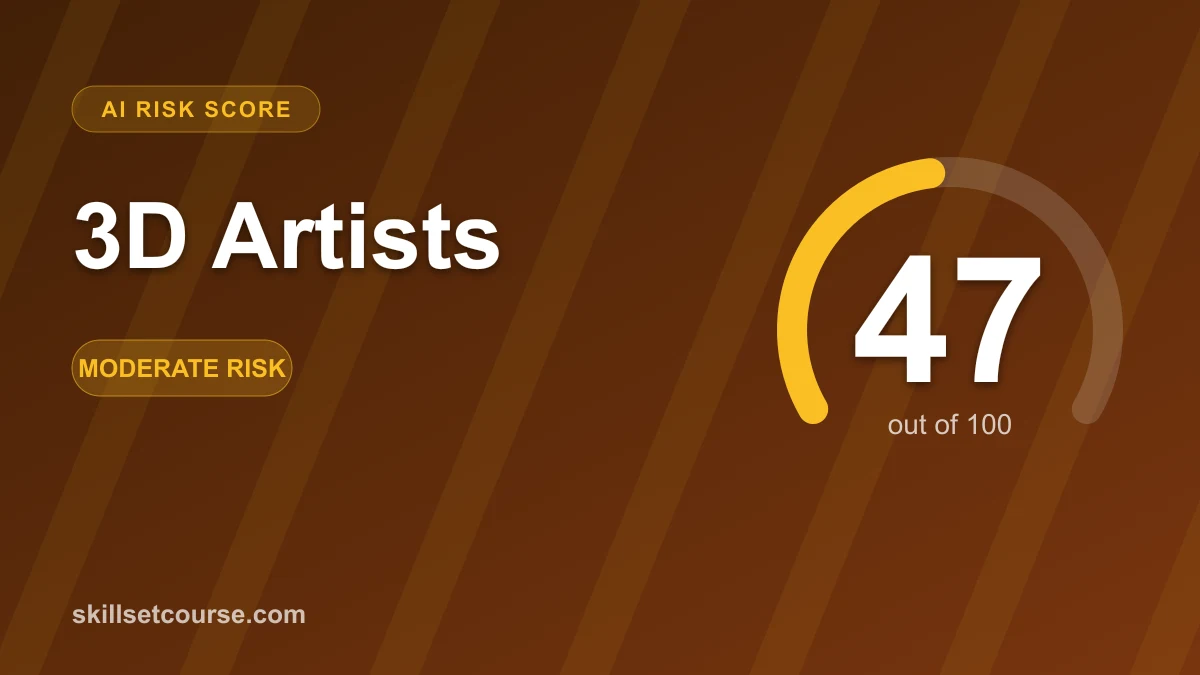
3D Artists have a moderate AI disruption risk with a score of 47/100. Generative asset production could automate 60-75% of tasks, but creative elements remain less susceptible to automation.
3D Artists face a moderate AI disruption risk with a benchmark score of 47/100. The primary challenge stems from advancements in generative image and asset production technology, which can automate 60-75% of typical 3D art tasks. While software like DALL-E and Midjourney enables rapid creation of assets and textures, the fields of creative design and conceptualization remain less susceptible to automation (estimated at an improbable 5-15%). This results from the uniquely human elements of artistic vision and creativity that cannot be replicated by algorithms.
Despite this, AI tools such as NVIDIA Omniverse and Blender's AI sidekick can significantly aid 3D artists by enhancing productivity through quicker asset generation and improved rendering times. Yet, these tools serve more as complements than replacements, allowing artists to focus on innovation and storytelling. In such a dynamic environment, many artists seek skill diversification, including learning new AI-enhanced workflows, as offered by platforms like Coursera, DeepLearning.AI, and Microsoft Learn.
For those interested in this evolving career, understanding the balance between technology and artistry is crucial. Skillset Course provides resources to explore how AI might change roles across the industry, while tools like /robo and /decide assist in navigating career transitions. Ultimately, AI in 3D artistry supports efficiency but does not endanger the artistic heart that drives the profession's core purpose.
Which specific tasks are most vs least automatable?
Tasks like asset production and rendering are highly automatable for 3D Artists (60-75%), whereas creative design and novel problem-solving remain less automatable (5-15%).
The landscape of 3D artistry is quite varied, and certain tasks are more susceptible to AI automation than others. According to current benchmarks, asset production and rendering for 3D Artists can be automated by 60-75%, owing to advanced capabilities inherent in AI tools like DALL-E, Midjourney, and NVIDIA's AI-enhanced rendering systems. However, tasks that emphasize creative design and novel problem-solving hold an automation probability of merely 5-15%, highlighting that genuine artistic insight and creativity still elude AI mastery.
Automation of 3D Artist Tasks
| Task | Automation Probability | Verdict |
|---|---|---|
| Asset Production | 60-75% | High automation risk |
| Rendering | 60-75% | High automation risk |
| Creative Design | 5-15% | Low automation risk |
| Novel Problem-Solving | 5-15% | Low automation risk |
The adoption rate of AI tools among 3D artists is increasing, yet the essence of storytelling and creativity remains central to their work. Artists frequently utilize platforms like /class and /expert to refine their skills and stay updated on AI advancements. Programs on Udemy and edX also provide valuable insights into balancing traditional and AI-powered processes.
How is the day-to-day role of 3D Artists actually changing?
3D Artists are increasingly integrating AI for more efficient asset generation and rendering, yet still manage creative and conceptual design, balancing technology with artistic vision.
The day-to-day role of 3D Artists is evolving with the integration of AI technologies, shifting the focus towards efficiency without sacrificing creativity. As AI tools such as Blender's AI features and NVIDIA Omniverse become embedded in workflow processes, artists find themselves moving beyond routine asset generation into more managerial oversight and strategic operation. Thus, the typical day for a 3D artist now often involves a hybrid of AI-driven task management and hands-on art creation.
3D Artists have begun extensively incorporating AI for accelerated rendering, asset optimization, and even real-time collaborative creation. This facilitates a greater focus on the conceptual and artistic direction of projects. Platforms focusing on AI-enhanced skills, particularly those offering courses on integrating AI into art via Skillset Course’s /decide and /alternative paths, become increasingly relevant.
With continuous updates in AI technologies, artists are encouraged to diversify their skill set, engaging with AI-powered design tools while maintaining their unique creative vision. For those entering the field or aiming to advance, learning stacks from LinkedIn Learning and Google Skillshop offer robust pathways to succeed amidst digital innovation. Despite technological integration, however, successful 3D artistry remains rooted in the creative balance, underlining the profession's resilience against complete automation.
Which AI tools should 3D Artists master now?
3D Artists should master tools like NVIDIA Omniverse, Generative AI models from Adobe, and Blender's AI features to enhance productivity in asset creation and rendering.
To remain competitive, 3D Artists should master cutting-edge AI tools that enhance design efficiency and creativity. NVIDIA Omniverse is a pivotal platform that enables real-time collaboration and simulation, which can streamline the rendering process. This tool is especially useful for handling complex projects where real-time feedback enhances workflow. Similarly, Adobe's Generative AI models are reshaping asset creation, allowing artists to effortlessly generate textures and models, thereby speeding up the ideation phase and reducing manual labor hours.
Blender's AI-enhanced capabilities also stand out, particularly its integration of machine learning features to optimize rendering processes and automate repetitive tasks. By incorporating these AI tools, 3D Artists can focus more on the creative aspects of their work, minimizing turnaround time without compromising quality. Investing time in mastering these technologies not only upgrades a 3D Artist's toolkit but also aligns their skills with emerging industry standards.
For further learning, Skillset Course directs users to platforms like Coursera and Udemy, which offer courses on leveraging Omniverse and Adobe's AI models. Exploring varied course offerings can expand your adaptability and specialization in 3D design. Consider visiting our Course Finder to discover specialized learning paths that can propel your career forward.
Which skills are rising vs losing value for 3D Artists?
AI integration skills like machine learning basics are rising in value, while traditional asset production skills may lose value as automation increases.
The rapidly evolving tech landscape is influencing which skills 3D Artists should prioritize. Integration of machine learning basics is becoming critical, with a salary premium of $15K-25K for those proficient in these areas. This knowledge helps artists utilize AI-generated models and assets effectively, staying relevant in the industry. Skills in leveraging AI-enhanced tools like Adobe Generative AI and NVIDIA Omniverse are now highly sought after.
Skills Facing Decline
Conversely, traditional skills like manual asset production are seeing diminished value as automation rises. Tasks such as standard modeling and basic texture creation are increasingly being automated; thus, time investment in these areas may yield lesser returns. As AI-enhanced tools become more prevalent, the demand for manual resource-heavy skills decreases, emphasizing the importance of upskilling in AI and automation areas.
To maintain and even increase market competitiveness, 3D Artists should examine Skillset Course’s AI-proof career resources that outline definitive pathways to upskill and adapt to these industry changes. Emphasizing adaptability and AI tool proficiency ensures artists maintain their relevance and continue providing unique value in their projects.
What realistic adjacent pivots are more resilient?
Adjacent roles such as UX design and VR environment creation are more resilient, requiring creativity and cross-functional collaboration less susceptible to AI automation.
With AI continuously transforming the 3D art landscape, exploring resilient adjacent roles can be a strategic move for 3D Artists. UX design is a promising path that leverages an artist’s existing skills in visual aesthetics and applies them to enhance user interfaces and experiences. This type of work requires collaborative cross-functional skills which are less susceptible to full automation.
Similarly, VR environment creation offers an exciting pivot opportunity. Designing immersive environments necessitates creativity and an acute understanding of spatial awareness, which AI tools have yet to fully replicate. These roles not only sidestep the current reach of AI automation but also capitalize on the growing demand for immersive digital experiences.
Skillset Course advises exploring courses that delve into UX principles or VR design fundamentals through platforms like LinkedIn Learning or edX. These alternatives could provide a resilient hedge against job displacement in current 3D Artist roles. For more comprehensive insights, consider using our expert guides to identify sustainable career paths that align with your skills and interests.
What if your job title is different?
The same AI Risk Score applies across the common job titles for this work. 3D Artists are also called 3D Modelers, 3D Visual Artists, 3D Character Artists, 3D Environment Artists.
Will AI replace 3d modelers?
3d modelers fall under the 3d artists analysis on this page, with an estimated AI Risk Score of 47/100 (Moderate risk). The main driver is the same: generative image and asset production (60-75%). Read the task-level breakdown above to see which parts of the job are exposed.
Roles that are often confused with this one
- Graphic Designers.
- 2D Illustrators.
- Animators.
Frequently asked questions
Is AI a threat to 3D artists?
AI poses a threat mainly in automating repetitive tasks, but 3D Artists continue to hold value in creativity and conceptual design.
Do 3D artists have a future?
3D Artists do have a future by focusing on roles emphasizing creativity, storytelling, and using AI as a collaborative tool.
Will AI replace 3D character artists?
AI may assist 3D character artists in modeling and rigging, but the story creation and personality design are less likely to be replaced.
What 3 jobs will not be replaced by AI?
Jobs such as creative direction, complex negotiation, and novel problem-solving are less likely to be replaced by AI due to their inherent human creativity.
Will AI replace Blender?
AI will enhance Blender by automating repetitive tasks, but it will not replace the software, as user input remains essential for creative projects.
Are AI tools beneficial for 3D artists?
AI tools like Generative Design and machine learning models are beneficial for 3D Artists in speeding up asset creation while supporting creative processes.
The bottom line
3D Artists face a moderate AI risk score of 47/100, driven by advancements in generative image and asset production. While automation poses challenges, embracing AI tools like NVIDIA Omniverse and Adobe Generative AI models can transform these into opportunities for growth. The single most crucial action now is to upskill in AI integration and machine learning basics, strategically repositioning towards sustainable roles like UX design or VR environment creation. For personalized guidance and course recommendations, visit Skillset Course’s alternative pathways to navigate these significant industry shifts effectively.